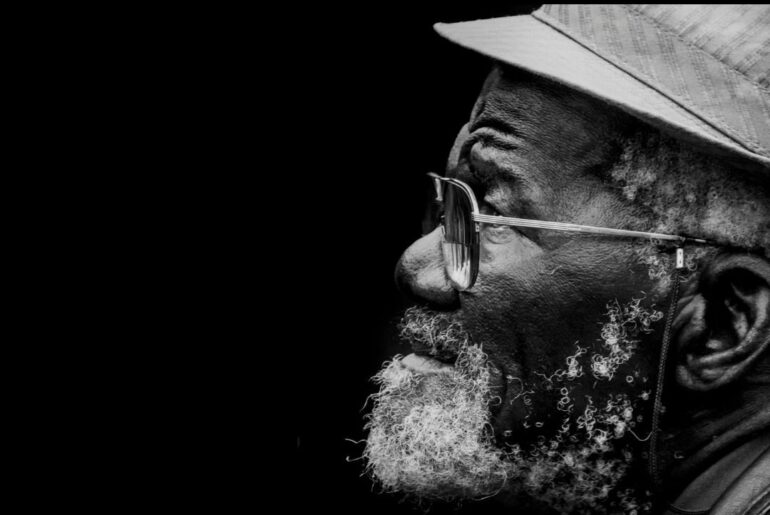
Photo Courtesy: Hush Naidoo Jade Photography
Based on true events
What do you do when your oldest son, the same one who has been the apple of your eye, is the one who lights up a bonfire to throw you in? What do you do when he faces you, a panga in one hand and hatred clenched in the other, ready to slice you into two equal parts, half father, half prey?
You run. You roll. You crawl from the once safe haven you called home that has suddenly turned into hell.
That is exactly what Mzee Charo did.
He ran, or at least he tried. But that was after his head had already been permanently disfigured by a panga wound. Despite his desire to escape, his seventy-something bag of bones could only get him so far before he was caught, carried back, and thrown into the bonfire. Yes, the same bonfire that his own son and his mates had started. And there, he was left to simply burn to death.
But life had other plans for Mzee Charo.
Against all odds, he managed to roll out of the fire and crawl into the wilderness before he was eventually rescued. The Chief became involved and somehow, despite everything, he survived.
As unfortunate as it is, this story is not unique to Mzee Charo. Hundreds upon hundreds of elderly people, especially men, have been killed across several coastal communities. Their crime? They have grey hair.
Peculiar as it sounds, there remains a belief that elderly people with grey hair are witches and therefore must be eliminated. But when you go deeper, witchcraft often becomes only the surface story. Beneath it, there is something else entirely.
Land.
Old people understand land in a way that is not just ownership, but memory, identity, and life itself. It is where families are raised, where culture is preserved, where faith is practised, and where generations remain rooted to who they are.
But for many young people, land begins to look different. To them, it is not memory but opportunity. Not heritage but unused wealth waiting to be turned into money.
And so the difference grows.
One generation considers land the REAL ESTATE. The other considers money the REAL WEALTH.
And so the hunger games begin, turning life itself into a battlefield, half father, half prey.
Within that hunger, some come to believe that the easiest way to access land is to remove the elders standing in their way. But how do you justify that kind of thing? How do you silence your conscience?
And that is where witchcraft becomes a convenient story. A label that makes the unbearable easier to carry out. A name that turns a parent into something disposable.
The matter had been going on for decades until a peace walk by the Malindi District Cultural Association MADCA, through the interior villages revealed something they could not ignore. Fresh graves, one after another. Stories emerged of elderly people, primarily men and some women, custodians of the land who had been attacked, killed, or forced to flee.
The same parents and grandparents who had spent their lives raising, feeding, clothing, and educating their children were now the ones facing the pangas and bonfires of those same children.
At the time, MADCA was simply a centre dedicated to preserving Mijikenda culture and heritage. But what they encountered changed everything.
They opened their doors to elderly people fleeing violence from their own families.
Some arrived with deep panga wounds. Others carried burns that never fully healed. Some did not survive. Others lived, but barely.
Mzee Charo was among those who survived.
But survival did not mean return. Many had lost everything. Their land. Their families. Their sense of belonging. Even their dignity. And they carried wounds that time alone could not heal.
Slowly, MADCA became more than a cultural centre. It became a refuge.
A place where the elderly could be treated, sheltered, fed, and most importantly, reminded that they still mattered.
Today, MADCA hosts about forty four elderly residents, with new cases still arriving every few weeks. Since 2011, hundreds of elderly people have passed through its care.
Beyond rescue, MADCA also began working on awareness and education, using films, cultural festivals, and community campaigns to challenge the beliefs that continue to endanger the elderly. Among these campaigns are slogans like “Mudzi ni Muthumia: My elder, my beacon” and “Mvi si uchawi, ni hekima”, a reminder that grey hair is not witchcraft, but a symbol wisdom.
MADCA has also worked to bring understanding between cultures and faiths, helping communities confront harmful misconceptions and slowly rebuild trust where it had been broken.
And so today, beneath the shade of trees at the centre, elderly men and women sit together. They weave baskets. They cultivate maize and vegetables. They prepare and sell snuff (ground tobacco), tend to the sick, and build traditional houses. They share stories. They practise their faith. In fact, one of the leaders is pioneering in writing books in their mother tongue. Others simply sit in a quiet that no longer feels like abandonment.
And on this World Elder Abuse Awareness Day, the story becomes more than memory. It becomes a reminder that what happens to the elderly is shaped by choices made in homes, in families, and in silence that is allowed to grow.
And yet, in the work of MADCA, something else is slowly taking shape. A different kind of future. A quiet rebuilding. A refusal to accept that this must be the ending. Through rescue, awareness, and campaigns, a new dawn is not something declared. It is something being built slowly, in shelters, in conversations, in changed minds, and in the dignity being returned to those who were almost forgotten.
And while Mzee Charo continues his recovery journey, his story remains a reminder of what is at stake when societies forget their elders.
Because growing old should never become a crime.
And because the people who once carried us through life deserve far more than fear in their final years.
***
Assalam aleykum warahmatullah wabarakatuh
Alhamdulilah my blog ‘Strokes of my pen’ has been nominated for the 3rd time by Bloggers Association of Kenya under ‘Creative Writing Category’.
I’m kindly requesting for your votes.
Here’s how to vote:
- Visit https://vote.bakeawards.co.ke/
- Enter your details then click ‘Next’.
- Scroll to the Creative Writing Category (number 3)
- Select ‘Strokes of my pen’ then scroll to the bottom and click ‘Next’.
- Click on ‘Send code via email’
- A verification code will be sent via email. Enter the code then click on ‘Verify’.
- Scroll to the bottom and submit.
Make sure you see the submission notification, otherwise, your vote didn’t go through!
Thank you in advance 😇