Tag

Ibadah


Browsing

Dear Pious Reader,

Can you feel it too? The gentle tug in your heart as Ramadhan slips through our days? Yet even as it departs, there are still blessings waiting to be claimed. As the anchor of Ramadhan is being unanchored, we should, if not must, tighten our belts and hold fast to the remaining blessings of these sacred days.

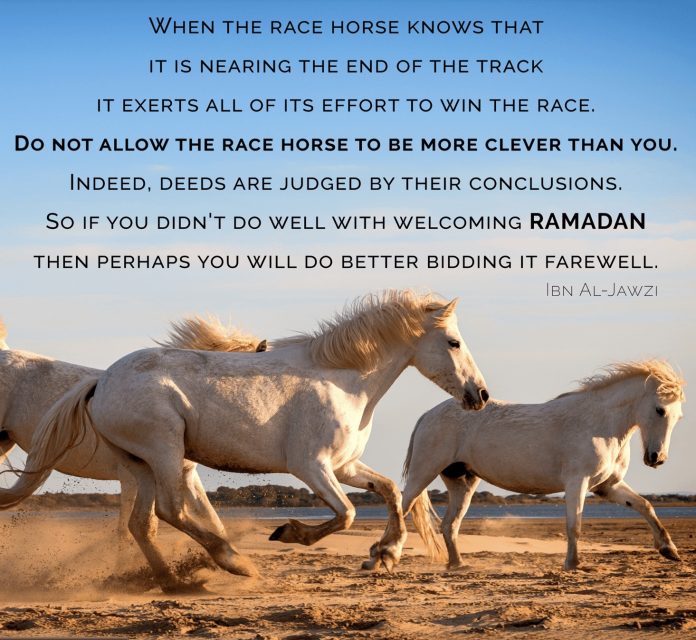
Let us ask ourselves: how are we planning to end this holy month? Perhaps we have not done our best in the days that have passed. Perhaps we missed Taraweeh, neglected the Qur’an more than we hoped, or held back the charity we intended to give. But Ramadhan is not over yet. The few days that remain could hold blessings worth a thousand years. For, as the Messenger of Allah (ﷺ) reminded us, “Verily, the deeds are only judged by their endings.”

The ache we feel in our hearts is not weakness; rather, it is awareness, the soul realizing that something sacred is passing. Ramadhan is guiding us, not because it is done with us, but because it came to show us who we could be. It arrives quietly, rearranging our lives, humbling our bodies so our hearts can attain taqwa, as Allah said, “O you who believe, fasting has been prescribed for you as it was prescribed for those before you, so that you may attain taqwa.”

And for a fleeting, merciful moment, we touch taqwa. Hunger softens us. Thirst disciplines us. The Qur’an speaks to parts of us we have long ignored. In the stillness of the night, when the world turns its back, our foreheads meet the ground, and our tears speak languages our tongues have never learned. Allah affirms this when He says, “Their sides forsake their beds; they call upon their Lord in fear and hope.”

Ramadhan soothes our hearts, stirs the depths of our souls, and proves that discipline is never impossible; closeness to Allah is never reserved for the righteous few. If we can change in these thirty days, then change is always within reach.

But now, dear pious reader, as the ship of Ramadhan prepares to sail beyond our shores, we face the most important question:

Are we passing through Ramadhan as a season, or carrying its transformation forward?

The true loss is not that Ramadhan is passing. The true loss is returning unchanged. The Messenger of Allah ﷺ said, “Whoever fasts Ramadhan out of faith and seeking reward, his previous sins will be forgiven.”

So if you stumble in these remaining days, return quickly. If you fall, repent faster. If the fire cools, remember how it once burned. For Allah has not moved; only the moon continues its course.

Let us honor these final days with sincerity, giving our best in prayer, Qur’an, and charity. And let our devotion not end when the month does. Let our days after Ramadhan testify that the lessons, discipline, and closeness we gain are not in vain.

Let our souls live and dwell in the presence of Allah. Let us grow closer, not just for Ramadhan, but for every day until we meet our Creator.

May these remaining days inspire you, dear pious reader, to carry the lessons and blessings of Ramadhan in your heart always.

Until we meet again,

Yours, the Soul Whisperer.

Everything declines approaching its end. That is the natural way of the world. Not even a blessed month is immune from this principle. The systems of inertia you hoped would carry for the entire ramadhan are quickly hijacked by an onset of laziness you had from before, and suddenly you missed your first jamaa, or you notice your daily qur’anic wird reducing, or you notice tarawih finishing quickly with your heart totally absent from it. This encroachment of heedlessness and fatigue sets in.

But Ramadhan is a month that is meant to offset everything. The month when we refuse to accept these habitual loops that we fall back into. The battle for the nafs comes into play and the purpose has always been to transcend ourselves. Ramadhan overhauls everything we deemed constant, from meal times we couldn’t negotiate to our nightly routines. Allah breaks this natural circuitry, enforcing in place these acts of refrain; the days of swabr through fasting and nights of gratitude through prayer where we really extend ourselves.

But despite our good intentions, the dip always happens, right after day 7 to the middle of the month, where we find ourselves having to drag our souls again. Suddenly, this heart that had been longing for its Lord becomes clouded again. You don’t say your dua with the same enthusiasm, the same conviction, repetition, the tarawihs are a bleep without contemplation; not just contemplation of the meaning, sometimes you don’t have the Arabic, but contemplation that these are the words of my Lord, my source of guidance, and yet I do not understand them, and that should sting your heart. And yet it’s reduced to the physical motions.

If you want to know where you stand before Allah, pay attention to where He’s made you stand. Allah makes easy for everyone what he created them for. One must worry when the ibaadah becomes a tad bit straining on them, because it confirms something about the state of their hearts. We embody the physicality of everything, but most often than not, we forget our hearts, the powerhouse of our actions. That is an illness in need of urgent attention.

There’s a lesser-known story of Umar ibn Abdulaziz, and he was who he was, which usually recalibrates everything for me. It’s found in the Hilya. One day after fajr, he went out, arriving at the riverside where, in that waned darkness, he sees Mujaahid ibn Jabr, the famous exegete whose name appears all over the tafsir. Mujahid sat there remembering Allah, weeping, and Umar observed him. Then Umar said to himself, ‘Woe to you, oh Mujahid, how am I supposed to stand before Allah on the same day that you stand before Him!’

Not a week goes by without me thinking about that. The day we will face account before a Benevolent Lord, presenting our deeds on the same day with Abu Bakr, and Umar, and Umar ibn Abdulaziz, and Mujahid. And like Umar ibn Abdulaziz, the thought of that inspires me to do better. And yet the heedlessness, the lack of foresight, the Hereafter being made a minutia in our eyes. 50, 000 years, Allah asks you about a couple of years of existence. A life when you talk about it yourself, you encompass it in a few minutes, and yet, 50,000 years; what do you think Allah will ask you about?

Everything? Then you must worry about everything. You must not make your Lord the least of those who see you. You must take chances and strive in the seasons He gave you as lifelines, to elevate yourself, and that is the purpose Ramadhan serves. The doors of hell are closed, those of paradise open, and a caller calls forth for your approach each night. Will you heed that caller and work against your instincts to slack and give it your all?

Years after years in regret, why not make this one the one you regret less? Allah loves the loftiest of ideals, why not make this Ramadhan the one you outdo everything. The life of the spirit is the real life despite our neglect of it, and Allah, the nurturer of our spirits, makes this month about that. How Generous! The boost acquired in it is supposed to last you the entire year, a practice to last you a lifetime. Are you going to take it?

Here we sit approaching the last 10. In it are the 10 best nights of the year, and of those is a night worth a thousand months. If your strategy was the inertia you hoped would carry you through the month, your resolve is most likely to be broken. The world seeps in as we prepare psychologically to transition to Eid and the days after. Society is working against you, and it’s not without intentionality that you will acquire the benefits of the 10 nights. Before you are days of striving, dear Muslim, which should always begin with interrogating the state of your heart. Where is it in this month? On what day did you leave it?

Before you were people who reserved these days for their Lord. They busied themselves remembering nothing else, and though that may seem impractical in a time when the world demands our constant presence, it’s only the recalibration of our hearts to some semblance of that that can ashore you to a ramadhan resembling the one of those who came before. Oh Muslim who was excited as this month entered, one should not become fully beat down approaching its most important days. Approach them not only as if this is the last time you’re approaching them, but also as if this is the first time you’re approaching them, wanting to really get them right, afraid of getting something wrong.

Study how the Salaf regarded them and pick a leaf from them, growing your deeds exponentially. We could never attain the levels of their piety, but effort must be exerted, for they are our examples. The taabi’in, some of them used to exert themselves, and when their bodies became weary, they would say, ‘Do the companions of the Prophet think they would beat us before our Lord?’ It was motivation for them, that awareness that they would stand before Allah and present their deeds on the same day with the Sahaba, and that would prompt them to stand up and exert themselves even more.

The opportunity presents itself now to go the unnatural way, because transcendence is the way of our religion. But more than anything, it’s to be reminded not to forget the most important thing, Ramadhan like every season of worship, is all about the relationship between a servant and His Lord. It’s about the state of your heart as you present yourself to Him. What is the state of your heart?


Dear Pious Reader,

I hope this message finds you basking in the blessings of Ramadhan. Yet, let us not forget the wise words of ʿAlī (RA): «الوقت كالسيف إن لم تقطعه قطعك» “ Time is like a sword; if you do not cut it, it will cut you.”

One week has already passed, and time continues to glide through this holy month. May we all be seizing the blessings that are so generously laid before us. Remember, these benefits are fleeting. For those striving, keep striving. For those still hesitant, do not despair. The past is gone, the future is uncertain, but we have today. Let us use it to sow the fruits of tomorrow.

Our beloved Prophet ﷺ reminded a man: “When you stand for prayer, pray as if it is your farewell prayer. Do not speak words for which you will have to apologize tomorrow, and give up hope in what is in the hands of people.”

What would change if we truly lived with that consciousness? If each ṣalah felt like our last? If each word carried the weight of accountability?

Let us take a firm stance today. Do not postpone good deeds. Do not procrastinate in doing what is right.

Finally, the Prophet ﷺ advised us to “Take advantage of five before five: Your youth before old age. Your health before sickness. Your wealth before poverty. Your free time before busyness. Your life before death.

My dear pious reader, let us invest in today for the benefit of tomorrow. Every good deed, every act of worship is a saving for the Akhira. If we desire to dwell in gardens of gold with eternal bliss, the time to start saving is now.

Until next time,

Yours, the Soul Whisperer.

I recently heard someone express a profound thought about charity that left me reflecting for a while. They said, “You might encounter a wealthy individual and share opportunities for good deeds with them, constantly reminding them of these chances. However, Allah may not intend to use that person to perform these good deeds. This could be due to their money not being pure or for any other reason that prevents them from having that opportunity. On the other hand, Allah might bring forth an unknown individual with very little to their name, yet He grants them the ability (tawfiq) to do good.”

For those involved in community service, this is a common observation. It’s not merely financial resources that inspire people to give; rather, their innate willingness, compassion, and sense of duty drive them to help others. One significant point we often overlook is that Allah, in His Encompassing Knowledge and Wisdom, determines who will do good and who will not.

An example of this is illustrated in Surah At-Tawbah, verses 41-47. In this passage, some Muslims made excuses to avoid participating in the Battle of Tabuk and sought permission from the Prophet Muhammad (peace be upon him) to remain behind. The Prophet allowed them to stay, but Allah (Subhanahu Wa Ta’ala) later revealed specific verses addressing this situation.

“No one would ask for exemption except those who have no faith in Allah or the Last Day, and whose hearts are in doubt, so they are torn by their doubts. Had they ˹really˺ intended to march forth, they would have made preparations for it. But Allah disliked that they should go, so He let them lag behind, and it was said ˹to them˺, “Stay with those ˹helpless˺ who remain behind.”

This principle extends beyond charity to all kinds of good actions, such as waking up for tahajjud, performing Hajj or Umrah, memorizing the Qur’an, spreading the message of Islam (da’wah), educating others, bringing happiness, aiding those in need, and being a supportive presence for others. Allah has intentionally selected you for these purposes. Have you considered the honour of that? That, amidst countless people, Allah chose YOU? He found you deserving of that chance to do good and receive the corresponding reward. He loves you, so He facilitates it for you!

The wonderful truth is that we all possess unique gifts and strengths in our faith to do good. Each of us is different in our approach and contributions.

Imam Malik illustrated this concept when he received a letter from a righteous person urging him to focus more on spiritual practices instead of teaching. He replied: “Allah, exalted is He, has distributed people’s actions just as He has distributed their sustenance. Sometimes He grants one person the desire to engage in optional prayers but not in optional fasting, or opens the door for charity but not for fasting, and so on. As for the pursuit of sacred knowledge, it is one of the most virtuous deeds, and I am grateful for what Allah has allowed me to do. I believe both paths are valuable, and I hope we are both striving for goodness.” (Al-Dhahabi, Siyar A‘lam al-Nubala)

This highlights that when Allah provides an opportunity and inspires a person toward a specific good deed, they should embrace that focus wholeheartedly. It’s important to also engage in other good actions without losing sight of what lies at the centre of their devotion.

The key question is: will you embrace the path Allah has set for you, or will you be among those who reject it?

Ultimately, Allah does not require our efforts, nor does He miss out if we fail to take advantage of the opportunities He gives us. He can effortlessly replace us with others to fulfil those same deeds.

Let us keep this in our hearts as a reminder whenever we face moments of lethargy that discourage us from rising for tahajjud, feeling reluctant to give sadaqah or a loan, or feeling fatigued when approached by those in need of our support. While we may feel ordinary, we have been bestowed an extraordinary honour. Consider how many individuals earnestly wish to visit Allah’s house but find themselves unable to do so. Reflect on how many genuinely desire to make a significant impact yet lack the necessary resources. Think of those who long to perform good for their parents but are left with memories, as those loved ones have departed from this world.

The next time an opportunity arises to do something good, I hope your heart overflows with genuine joy and excitement. I hope that you take that chance as if it were the final one you might ever encounter. I hope you don’t hesitate to go above and beyond, putting in the extra effort and dedicating yourself fully to the task at hand. When you take that chance, I hope you carry it proudly, wearing it as a badge of honour that reflects your commitment to making a positive impact on the world.

Dear Reader, take a few moments to engage in thoughtful contemplation about the unique purpose that Allah has set for you. Fully embrace this profound calling with all your heart and dedication, recognizing the significance of your role in the fabric of goodness in this world.

Here is a dua to help you and me continue doing good deeds:

Yahya related to me from Malik that he had heard that the Messenger of Allah, may Allah bless him and grant him peace, used to make dua saying, “O Allah, I ask you for good actions and for leaving what is disapproved of and for love of the poor. And if You wish to try people, then bring me to You without being tried.”

Allahumma inniy asa’luka fala’l-khayrati, wa tarqa’l-munqarati, wa hubba’l-masakin, wa idha aradta fi’n-nasi fitnatan fa’qbithni ilayka ghayra maftun.
اللَّهُمَّ إِنِّي أَسْأَلُكَ فِعْلَ الْخَيْرَاتِ وَتَرْكَ الْمُنْكَرَاتِ وَحُبَّ الْمَسَاكِينِ وَإِذَا أَرَدْتَ فِي النَّاسِ فِتْنَةً فَاقْبِضْنِي إِلَيْكَ غَيْرَ مَفْتُونٍ

May Allah make us a source of goodness for every place we set foot in and every soul we meet, and may we be honoured to be among the agents of kheyr in our lifetime, Ameen.

Allah Subhanahu Wataala did not lie when He said:

“The example of those who spend their wealth in the cause of Allah is that of a grain that sprouts into seven ears, each bearing one hundred grains. And Allah multiplies the reward even more to whoever He wills. For Allah is All-Bountiful, All-Knowing.” (Suratul Baqarah, Verse 261)

I recently came across the story of Hamza, a 56-year-old man who was jailed at the age of 16 after accidentally firing a gun which led to the death of his loved one. While in jail, he became a devout Muslim and had been pleading for parole for years. Forty years later, Hamza is finally going to be released at the end of March in shaa Allah. But here’s how one act of kindness has changed his life entirely.

Hamza was working as a janitor at the prison which earned him 13 cents per hour only. Yet what he got from the 136 hours of tough labour, a total of 17$, Hamza donated all to Gaza.

Justin Mashouf, a filmmaker who was in correspondence with Hamza, shared his story on X (Twitter). Touched by this noble act of kindness, his story quickly went viral and Justin created a gofundme campaign to empower Hamza to transition back into society with dignity and security after years of imprisonment. A total of USD 102,187 was raised until Hamza requested that it be suspended (after thanking all the donors of course). Instead, he requested the donors to consider helping the suffering children, mothers and fathers of Palestine, Yemen, and Africa living under inhuman conditions. 

When I first saw the fundraising, the goal was 40,000 USD. This was more than double that. Subhanallah!

Allah Subhanahu Wataala tells us in Suratul Baqarah, Verse 265:

“And the example of those who donate their wealth, seeking Allah’s pleasure and believing the reward is certain, is that of a garden on a fertile hill: when heavy rain falls, it yields up twice its normal produce. If no heavy rain falls, a drizzle is sufficient. And Allah is All-Seeing of what you do.”

Isn’t it mind-blowing that Allah Subhanahu Wataala inspired Hamza to do this act, a mere weeks before his release (in shaa Allah)? Can you imagine what kind of worries Hamza might have had (or not) about going back into the world after 40 years?! A different name, a different religion, a totally different era, jobless, homeless, with no money. Yet the heaviest of all is the concern of whether the community would embrace him upon his release. And subhanallah, just like the best of planners Allah is, He brought a way in which Hamza got all he could ask for, at least in terms of livelihood and community, at the eleventh hour!

Someone once told me of a time when he gave a guard lunch money, it was very random, and that same day, someone he had been referring clients to, randomly tipped him ten times what he gave the guard. Literally ten times! Mind you, this had never happened before and was quite unexpected. And he told me something that really struck me. He said, ‘I pity those who don’t believe in Allah.’ And I thought, yeah! What a great loss to not know, see and feel God’s love and mercy and kindness?!

I’ll never stop preaching about charity because I have read, watched and witnessed the miracles of giving. I have seen how much Allah can give and give and give. And the stories are too many to count.

We are just a few days to Ramadhan and many people are planning menus, festivities and early Eid shopping. Let us dare be different by planning for more ibadah and charity, charity, charity! 

Times have been increasingly tough, not just in our country, but in the entire globe. But that should never limit us from giving because you know what? We have a very generous Lord, and what you give, especially when it is difficult for you to do so, will never go unrewarded. Charity does not make you poor, it elevates you more than you can imagine.

The prophet peace be upon him said: “Charity does not decrease wealth, no one forgives another except that Allah increases his honour, and no one humbles himself for the sake of Allah except that Allah raises his status.” (Sahih Muslim 2588)

Let us have our intentions set, ready for Ramadhan, and let us put in effort to make it a more productive one than it ever was.

May we all live to experience the holy month and may we be among those whose lives will transform for the better, ameen. Ramadhan Mubarak good people! Please do remember me and my family in your duas 🙂

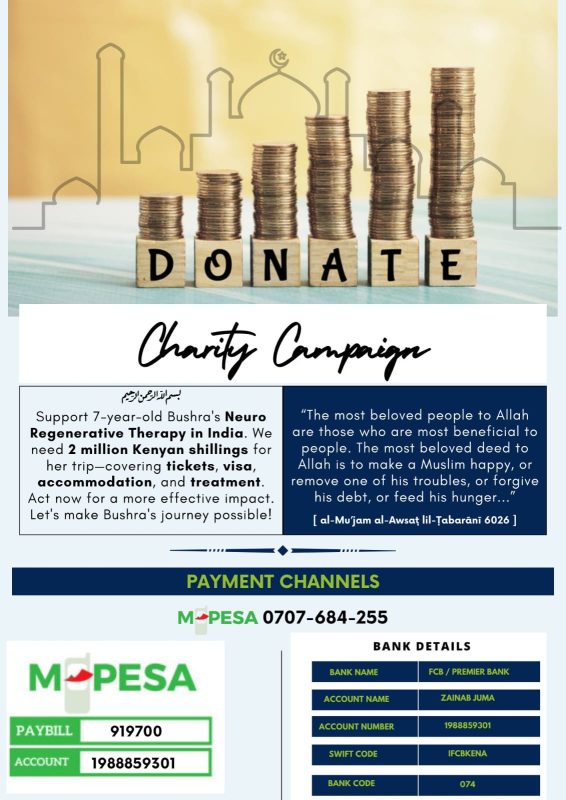
That said, here is a charity opportunity you can begin with:

Hamza’s story source: https://www.gofundme.com/f/help-a-generous-soul-reenter-society-from-prison

Powered by WordPress