
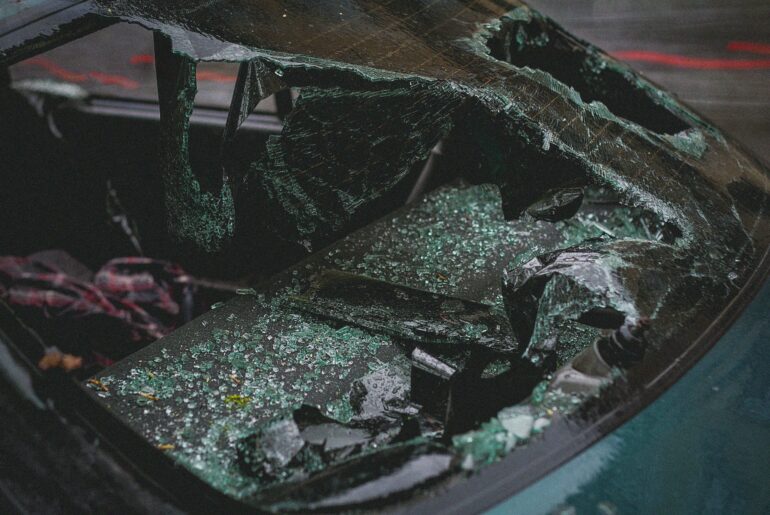
I had imagined this a million times, maybe.
The speeding. The swerving. The crash.
I had cried about it. I had panic attacks more times than I could count. In my silly, silly brain, I thought my imagination could equate reality. That I had rehearsed this scenario from all angles, whether it was a wreck, a collision, a rollover, such that I would be prepared if it ever happened.
But when we were mid-air, everyone shouting their lungs out, I quickly realized there is never enough preparation for this.
Reality is way more terrifying.
It felt like I was looking right into the eyes of death. Like my end is here. I started to say the shahada.
And even then, I knew. I KNEW. What Allah was trying to show me. The perfect illustration of a verse I had read literally two minutes ago.
—
I am okay. Alhamdulillah.
I know, I know. I should have started with that. But what’s the fun in that? 😀
Now, let’s rewind to where it all started.
—
Earlier this week, my sister and I were walking to the matatu stage, each silently reading their adhkar. Out of the blue, I remembered a reel I saw on Instagram maybe one or two days earlier. A content creator, Sukaina, excitedly shared how she taught her child the dua whenever they boarded their car:
“سُبْحَانَ الَّذِي سَخَّرَ لَنَا هَذَا وَمَا كُنَّا لَهُ مُقْرِنِينَ وَإِنَّا إِلَى رَبِّنَا لَمُنْقَلِبُونَ”
“Glory to Him Who has subjected this to us, and we could never have it by our efforts. And indeed, to our Lord, we will surely return.”
This was so random because at the time, I wasn’t even following Sukaina’s page. That video simply appeared on my feed. And of course, I replayed it a few times as she and her child cutely sang the dua in the Omar and Hana style, Allahumma bareek.
I turned to my sister and said, “Whenever I want to recite this dua, I can’t keep Omar and Hana’s voice out of my head, so I just end up singing it like they do instead.”
My sister laughed.
“This dua is for travel, right?”
“For mounting any animal or vehicle too.”
Then, in her typical Qur’an student style, she said, “The verse actually starts like this:
وَٱلَّذِى خَلَقَ ٱلْأَزْوَٰجَ كُلَّهَا وَجَعَلَ لَكُم مِّنَ ٱلْفُلْكِ وَٱلْأَنْعَـٰمِ مَا تَرْكَبُونَ ١٢
لِتَسْتَوُۥا۟ عَلَىٰ ظُهُورِهِۦ ثُمَّ تَذْكُرُوا۟ نِعْمَةَ رَبِّكُمْ إِذَا ٱسْتَوَيْتُمْ عَلَيْهِ وَتَقُولُوا۟ سُبْحَـٰنَ ٱلَّذِى سَخَّرَ لَنَا هَـٰذَا وَمَا كُنَّا لَهُۥ مُقْرِنِينَ ١٣
وَإِنَّآ إِلَىٰ رَبِّنَا لَمُنقَلِبُونَ ١٤
“And He is the One Who created all things in pairs, and made for you ships and animals to ride, so that you may sit firmly on their backs and remember your Lord’s blessings once you are settled on them, saying, ‘Glory be to the One Who has subjected these for us, for we could have never done so on our own. And surely to our Lord we will all return.’”
(Surat Az-Zukhruf: 12 to 14)
She reflected on the ayah. Allah tells us that He is the One who made it possible for these animals and vehicles to move. It is by His will, His power and His mercy, not human intellect or ability. This is among His signs that we need to contemplate and thank Him for. For making it possible. For making it happen with ease. He reminds us too that life and death are in His hands. And at the end of the day, we all return to Him.
We chit-chatted a bit about the verse, reflecting upon it. Then we started saying the dua together, word after word. And just like that, we were already at the stage.
Matatus were lined up in front of us, conductors calling out, urging us to board theirs. We decided to get into the first one that was going express. I sat in the seat right behind the conductor’s seat. My sister went to the far-left seat by the window. Soon enough, the matatu was full. The conductor decided to squeeze in an extra passenger, who went and sat next to my sister.
We left.
I can’t even tell you if a minute had passed or two. It was just a matter of seconds when the car hit a bump roughly and we were thrown into the air. At first, we thought the driver had just been careless, maybe had increased speed abruptly. So there were shouts of “Wewe! Oya dere!”
But soon it became clear this was not just reckless driving, the brakes had stopped functioning. The car was out of control.
The car started swerving left and right. The shouts increased. I kept shouting “Allahu Akbar! Allahu Akbar!” I don’t even know why that was the first dhikr that came to mind.
We swerved left, and I watched the moment our matatu knocked a man off his feet. My stomach dropped. I couldn’t believe what I was seeing. His body flew, and the world around me seemed to tilt sideways. My heart pounded so hard I could hear it in my ears. I was frozen, unable to move, unable to breathe properly. My mind couldn’t process it fast enough. This is real. This is happening. A cold wave of fear washed over me. My chest tightened, my hands trembled, and all I could do was cling to my seat and keep repeating, Allahu Akbar, Allahu Akbar.
The only thought that came to mind was, I am about to die. I should be saying the shahada instead.
So I started, “La ilaha illa Allah…”
And then boom!
Our matatu rammed right into the car in front of us. A tuktuk crashed into the other car on the side. That’s when the Matatu finally stopped.
And when it did, I let out the loudest, ugliest cry.
I was trembling, gasping for air, and frozen in place as the conductor flung the door open and people hurriedly alighted.
Someone behind me quickly tapped my back, “Shuka! Shuka!” and I staggered my way out, still weeping, barely able to catch my breath, not even caring that there was a crowd around.
My younger sister alighted and came to hug me, holding me, trying to comfort me. As if we weren’t both in the same accident. As if we hadn’t both been exposed to that same horror. “Alhamdulilah, say alhamdulilah,” she repeated.
I was weeping uncontrollably. I.just.couldn’t.stop. (Those who’ve ever experienced/witnessed panic attacks, you know what I mean).
Some people came to ask if I was hurt. I just shook my head because I couldn’t even speak. An older man kept saying, “Pole mamii. Pole mamii. Umeumia?” which was a bit funny because I really think he saw me with my backpack and rubber shoes and assumed I was a school student.
It reminded me of another time I had a similar panic attack on the road. I had to squat because my legs couldn’t hold me. The road was mostly deserted. A man passed by, hesitant to come near, and shouted, “Uko sawa?” I couldn’t speak. Then he asked, “Are you drunk?” I was weeping loudly, trembling, gasping for air, just like now. And yet, amidst my tears, I couldn’t help but chuckle at the absurdity of it all. Fun times 😀
Eventually, my panic attack ended.
I finally got to look around me.
The lady who had been seated at the very front beside the driver was now sitting on the ground. She had hurt her back and waist and was grunting in pain whenever she tried to move. Everyone was just staring. I remember thinking she needs to go to the hospital.
But no one was moving.
Call a tuktuk to pick her up. No one moved.
It was strange. That stillness. That collective pause. Everyone waiting for someone else to act first.
That was when I realized that the bystander effect is a very real thing.
My sister and I started looking around for a tuktuk. There was so much commotion and traffic. The lady was silently crying. The woman holding her, who I assumed was her sister, was in tears too.
Eventually, one tuktuk came and she was taken away.
I did get to see the man we had knocked down, seated on the ground, unable to move. I am not sure if anyone else was injured because we left the scene shortly thereafter. (I really do pray that they’re all okay and well by now, ameen).
All I could think of was that verse.
“And He is the One Who created all things in pairs, and made for you ships and animals to ride, so that you may sit firmly on their backs and remember your Lord’s blessings once you are settled on them, saying, ‘Glory be to the One Who has subjected these for us, for we could have never done so on our own. And surely to our Lord we will all return.’” (Surat Az-Zukhruf: 12 to 14)
I turned to my sister, tears in my eyes.
“Do you know, I rarely ever say this dua. Except for a few times when we are with the kids, and we sing it in that Omar and Hana style. But personally, I hardly say it. What are the odds that Allah would make me remember a random video on Instagram, from a page I wasn’t even following, and make us say it today?”
She said, “I rarely say it too. And it is Allah who made it easy for us to say it, on the right day, at the right time. Subhanallah.”
“I feel like Allah wanted us not just to read the verse, but to live it. To experience it. To truly understand His words. And to be grateful for His favour upon us,” I said.
She nodded, then said, “You know, in Surat Ash-Shura, Allah says something similar: ‘And among His signs are the ships like mountains sailing in the sea. If He wills, He can calm the wind, leaving the ships motionless on the water. Surely in this are signs for whoever is steadfast, grateful. Or He can wreck the ships for what the people have committed, though He forgives much.’”
Tears started falling again.
Later on, I realized that in the verse before that, Allah says: ‘You can never escape Him on earth, nor do you have any protector or helper besides Allah.’” Subhanallah.
After a brief pause, she added, “You know, when we boarded the matatu, I looked up at the sky and noticed a beautiful cloud with a flock of birds beside it. I was amazed and said, ‘Subhanallah!’ Then I remembered the dua again, so I repeated it.”
Then she went on to say, “And when the extra passenger came and sat beside me, I was a bit bothered because now we were seated four instead of three. We were squeezed. But at the road bump, when the matatu threw us up, we didn’t have much impact because there was no space between us. We could have gotten hurt had we been seated normally. Subhanallah.”
Indeed, we may dislike a thing, but it is khayr for us.
(If you own or drive matatus, please don’t use this as an excuse to overload 😀)
You know what the craziest part of all this is?
The previous night, the very last thing I had worked on was editing a friend’s book on adhkar. And the story revolved around a car malfunction and an accident. On top of that, earlier this year, I had told my inspirational sister, who’s far ahead in her Qur’an journey, that I wanted to be more intentional with tadabbur al-Qur’an.
Lo and behold, Allah decided, why just reflect when you can actually experience the verses 😀
Alhamdulillah, truly. My sister and I are okay. I did have a very slight injury on my knee, but now, whenever I walk and that pain kicks in, I remember to be more grateful. This is nothing. It could have been way, way worse. In the span of just a few minutes, two or maybe three, our lives could have ended or changed completely. One moment, we were walking to the matatu, calm and thinking about our adhkar. Next, we were in the middle of chaos, staring death in the face. It makes you realize how fragile life really is, how vulnerable we are as humanbeings, how quickly circumstances can shift, and how precious every single moment truly is.
A friend joked that this was exposure therapy for my constant fear of accidents. Who knows? All week, whenever a car oversped or went roughly, my sister and I would exchange tense looks, then chuckle softly. There’s that katrauma, that tightening of the heart. But at least now, we can smile about it.
Alhamdulillah for the gift of life.
Alhamdulillah for Allah’s favours upon us.
Guys, don’t FORGET YOUR ADHKARS & DUAS!
Side note: For influencers, and really, anyone who uses social media, may this be a reminder that whatever you post may positively or negatively impact someone’s life. Whether directly or indirectly. Sukaina may never know that a cute, simple video with her child, reminding people of a dua, may have been part of our protection that day.
Who knows?
Be conscious of what you share.
It may make all the difference in someone’s life.