Author

Lubnah Abdulhalim


Browsing

Have you ever witnessed abuse taking place and you feel the urge to shout at the victim, “WHY DON’T YOU JUST LEAVE?!” because for you, it is as simple as just that? You feel, if only they knew their worth, if they were strong enough, if they weren’t too naive, they’d have left already. Right?

Well, it isn’t as simple as that. There’s a lot of complexity and psychologically distressing processes involved. Sometimes, a trauma bond is formed.

When we talk of trauma bond what do we actually mean? And how does it relate to abuse?

First of all, let’s get the myths out of the way. Trauma bonding does NOT mean bonding/ feeling connected to someone cause they understand your trauma or they’ve undergone similar traumatic experiences. You’ll find the word trauma bonding being misused in a lot social media platforms to mean the above. For example, you’d find friends describing their relationship as a trauma bond because they formed a close relationship over similar traumatic experiences they experienced (whether individually or together). However, trauma bonding actually means an intense emotional attachment between the abuser and the victim characterised with repeated cycle of abuse, devaluation and positive reinforcement.

Ivy Kwong LMFT, a therapist who specializes in healing trauma explains, “A trauma bond develops in relationships where there is a power imbalance and a cycle of reward and punishment. The abuser is in a position of power over the person being abused and alternates between hurting and soothing them.”

Trauma bonds are thought to be the result of unhealthy attachments. As humans, we are hard-wired to form attachments to people that we see as defenders, protectors, or caregivers to survive. As such it is believed that trauma bonds often form from our brains looking for survival methods. This is also known as the paradoxical attachment.

Additionally, it is worth noting that not everyone who experiences abuse forms a trauma bond. However, more people may be more prone to such toxic cycles due to their early experiences, which makes them stick around, some to the point of death.

During the phases of abuse, the abuser may apply tactics such as threats of harm, manipulation, control, shaming, gaslighting and sabotage. These are then mixed with intermittent phases of displays of affection, love and kindness, which create a confusing and addictive emotional rollercoaster.

There are many situations in which trauma bonding may take place. We mostly see this toxic cycle in movies and books on domestic violence where a woman or even a man could be physically and severely injured, then the following day, the abuser is on their knees with a huge bouquet of flowers or an extravagant gift, crying and begging saying they don’t know why this happens and promising to change and the woman somehow trusts them and gives them another chance (could even be 157478 chance yet they still give it). Then they go back to the same behaviour two days later. Familiar right? That’s an example of a trauma bond. But domestic violence is not the only scenario that trauma bonding takes place. Other scenarios include:
Incest, sexual abuse, cults, elder abuse, kidnapping (Stockholm syndrome), human trafficking and child abuse.

Trauma bonds can also happen in a dysfunctional family system, workplace, and even in religious groups, but we most commonly associate trauma bonds with toxic romantic relationships.

Signs of a trauma bond:

These include:

  1. An immediate, intense emotional connection that feels overwhelming, often mistaken for love. Unlike love, this connection forms rapidly, while love typically develops over time.
  2. A sense that the relationship is damaging, yet the thought of leaving seems impossible.
  3. Constantly justifying, downplaying, or making excuses for the treatment received, or even keeping the abuse a secret to protect the abuser.
  4. A feeling that this person is the only one who can offer love or understanding, creating a sense of being stuck despite the pain.
  5. Being told that better treatment or love would be received if only there were changes, yet the expectations continue to shift every time a change is made.
  6. A constant effort to gain approval or affection, regardless of the mistreatment, driven by a deep need for acceptance.
  7. Emotional dependency, with a strong reliance on the other person for emotional stability.
  8. Believing that affection from the abuser offers healing, when in reality, manipulation is what keeps one trapped.
  9. A relationship motivated by the fear of abandonment, leading to anxiety and insecurity.
  10. Frequent preoccupation with the abuser and the relationship, leaving little mental space for anything else.
  11. Intense highs—moments of affection and love—interspersed with devastating lows marked by pain and manipulation.
  12. The abuser isolates the victim from family and friends, deepening dependence on the relationship.
  13. Fear of retaliation when attempting to leave.
  14. A tendency to fixate on the “good days,” using them as proof that the abuser cares.
  15. The goalposts continually shift, making it feel like the target of acceptable behavior is never quite within reach, regardless of the efforts made.
  16. Perceiving anyone who encourages you to leave as an enemy.
  17. The unpredictability keeps the victim hooked, believing the love is worth the pain. They view their love as a lifeline while it is actually the anchor that drags them down.

Stages of a trauma bond:
Though each trauma bond is unique, they often involve a version of the common patterns listed below.

Here’s a breakdown of each stage:

  1. Love Bombing: The abuser showers the victim with excessive affection, attention, and praise, making them feel special and loved. This creates an emotional high and makes the victim feel like they’ve found the perfect relationship.
  2. Gaining Trust: The abuser works on gaining the victim’s trust by appearing caring, reliable, and supportive. The victim becomes more dependent on the abuser, believing that they have someone who truly understands them.
  3. Criticism: Slowly, the abuser begins to criticize the victim, pointing out their flaws or making them feel unworthy. The victim starts to feel insecure, unsure of themselves, and may try to please the abuser to avoid more criticism.
  4. Manipulation: The abuser manipulates the victim’s emotions, often playing on their guilt, shame, or fears. The victim may start doubting their own perception of reality, making them more likely to tolerate further mistreatment.
  5. Resignation: The victim begins to feel powerless and hopeless, believing they can’t escape the cycle of abuse. They may accept the mistreatment, feeling like they don’t deserve better or that things will never improve.
  6. Distress: The victim experiences emotional pain, confusion, and distress from the ongoing abuse, but they often struggle to break free from the bond. This distress can lead to feelings of isolation, anxiety, and emotional exhaustion.
  7. Repetition: The cycle repeats itself, with moments of kindness or promises of change from the abuser, which leads the victim to hope things will get better. This cycle of abuse, remorse, and false hope makes it difficult for the victim to leave the relationship.

These stages form a damaging loop that keeps the victim emotionally attached to the abuser, making it very difficult to break free from the toxic relationship.

“The person being abused may feel conflicting feelings like shame, love, self-blame, terror, relief, anxiety, gratitude, and fear towards the perpetrator. They often feel responsible for the feelings of the person who is hurting them and may try to continually please or appease the abuser,” says Kwong. This makes it even more difficult to break the bond.

How can one heal from a trauma bond?

  1. Acknowledge the truth and validate the pain you’re experiencing
    Recognize the pain caused by the trauma bond and accept that the feelings of confusion and hurt are valid. This is the first step toward healing.
  2. Be willing to let go
    Let go of false hope and attachment to the abuser. Accept that the relationship is unhealthy and freeing yourself is essential for healing.
  3. Seek help & support from a therapist/trusted family and friends/support groups
    Reach out to a therapist or trusted individuals who can offer guidance and understanding. Support groups can help you feel less isolated in your healing journey.
  4. Focus on self-love and healing
    Rebuild your self-worth through self-care and daily positive affirmations. Prioritize your emotional health and rediscover joy outside the trauma.
  5. Set boundaries to protect yourself
    Establish clear boundaries to protect your emotional well-being, including cutting off contact with the abuser if necessary. In other circumstances, you may need to set a safe exit plan if you fear for your safety when you cut them off.
  6. Take time to grieve what you lost
    Allow yourself to mourn the loss of the relationship, including the future and hopes you once had, and give yourself space to process the grief.
  7. Embrace the lessons and growth you’ve achieved through the experience
    Recognize the strength and wisdom gained from the experience. View the journey as an opportunity for personal growth and greater self-awareness.
  8. Practice mindfulness and foster self-esteem
    Focus on activities that promote emotional well-being, such as mindfulness, prayers, or journaling. These practices help stay present, reduce stress, and nurture self-esteem.
  9. Cultivate a mindset of self-compassion and avoid self-blame
    Embrace the understanding that being in a trauma bond is not your fault. Practice shifting from self-criticism to self-kindness. Remind yourself that healing takes time, and the process of recovery is about learning, not punishing oneself. Consistently practicing self-compassion can build emotional resilience and reinforce a positive relationship with oneself.

If you happen to know a trauma bond victim, don’t be quick to judge their inability to step out of the cycle. Remember to extend grace and most importantly, be their support system, help them set up a safe exit plan and be part of their journey of rediscovering themselves post the relationship. Victims often carry a lot of shame with them and how supportive the individuals around them are (or not) will greatly impact their healing journey.

Resources:

  1. verywellmind.com
  2. healthline.com
  3. attachmentproject.com
  4. psychologytoday.com
  5. apn.com
  6. @igototherapy via IG
  7. @quantafreedomhealing via IG
  8. @ellelouisemcbride via IG
  9. Chatgpt

My dear readers,

Writing has transformed into a rare luxury for me, a cherished activity often sidelined by the relentless demands of daily life. It’s something I can only engage in after tackling a mountain of chores, navigating the complexities of finances and taxes, and finding a way to retreat into solitude for days, searching for that elusive moment of inspiration. I can almost hear my own voice echoing, “I used to write, you know… but then life happened…”

There was a time when I was convinced that if I fueled my inner fire with enough passion and determination, I could carve out precious moments for the things I love. Spoiler alert: Wrong! It seems that adulthood should come with a warning label, as writing is certainly not the only thing I’m falling behind on. The responsibilities and complexities of growing up seem to pile up, making it challenging to keep pace with everything I once managed so easily. The only silver lining of this madness is that I know I am not alone.

Things have been changing drastically and without warning. As they say, ‘hii syllabus inaenda mbio’. For example, since when did I start taking evening tea? Who am I?! Or why is it taking me 3 to 5 business days to watch one true-crime documentary or just a feel-good movie, something I used to do in one night? Or why are kids expecting eidiya (eid gift tokens) from me? Or why am I now listening to full speeches during school events? Mind you, school events of my nieces and nephews who have ME as their NEXT OF KIN. Crazy, right? Ain’t I ‘children’?

Remember my obsession with kids, how I thought my sole purpose on Earth was to nurture tiny humans? Flash forward to now, and I’m much more of a “Why are they so energetic?” kind of gal. Don’t get it twisted; I still dream of being a mother someday, in shaa Allah, but can I survive the chaos? So many questions swirling around in my brain.

My outings with friends have become increasingly rare, and what once resembled a social life has faded away. When we do manage to escape our daily routines, our conversations now revolve around recipes, the challenging economy, and complaints about conflicts with the “senior citizens” at work. We often express our disbelief at the high expectations placed on school children today and lament the outrageous prices of curtains. Oh, how times have changed! We no longer dream about the latest Converse sneakers or trendy backpacks; instead, our wish list includes air fryers, vacuums, and dumbbells.

We’ve shifted from reading Khaled Hosseini’s beautifully written novels to exploring books on narcissism, trauma, and healing (if we ever get the time to do that anyway 😉 ). Whereas we used to ignore politics, we now find ourselves tweeting and retweeting about how the system and government have failed us. It’s astonishing how practical and logical we’ve become!
Weekends? Oh, they now consist of barricading myself inside the house like a hermit from dusk till dawn, only to emerge for Monday’s inevitable grind. And here I thought I was an introvert! There’s a whole new level, my friends, where you avoid talking to anyone, loud noises are such a pet peeve and you realise that proving your good intentions during arguments isn’t worth the energy anymore.

Some days, I catch myself sending out Friday forwards, and suddenly it dawns on me: Am I this close to sending the obligatory “Good Morning” gifs and duas filled with flowers and birds chirping? All this because starting a conversation feels like trying to jump-start a dead car battery. Sleep has become my sole desire, a comforting escape from daily chaos. The only times we go out are for sad funerals or happy weddings, which are the rare moments we step away from our routines to connect with others.

Remember when I used to be fun? Sharing memes on my WhatsApp status like my life depended on it? Well now we have the ugly reality of wars and oppression and violence right on our faces which makes me question: was it always like this or were we just totally oblivious? My God! Did they actually mean it when they (the older generation) kept saying, ‘Kupumzika ni kaburini?!’

However, if there’s anything, adulting really humbles you. You truly get to appreciate life for what it is. The back and knee pains remind you of the blessing of health. The little moments you get to spend with friends make you value them more. You learn the importance of choosing your battles because you realize how precious your time and energy is. You start appreciating homemade food more because you understand it’s not just food; it’s love in a Tupperware container plus, money is saved! (our parents were right aye?!  ) Most importantly we get to extend a little (a lot) more grace to our parents. We understand them better now. We understand how much they endured to make us what we are today. We understand how much they sacrificed. How much they TRIED. We understand that they don’t have much time anymore and every single day, every single moment with them is a gift and a blessing.

For most of us millennials, this journey through adulthood is like a wild roller coaster with no safety bar. We’ve hopped between worlds—playing outside until dusk and then watching kids who have never known a life without screens. We’ve seen the highs and the lows, and yet, here we stand. With a bit of a prayer for serene days, wiser decisions, and an abundance of consciousness, let’s raise a metaphorical toast to the new adults navigating this exhilarating circus we call life! Cheers!

Inspired by KonoozTube (on YouTube)

In our perception of wealth, we’ve traditionally categorized people into three main groups: the poor, the middle class, and the rich. However, the reality of wealth distribution is much more intricate than these broad categories suggest. Within the category of the poor, there are various levels of economic hardship. Some individuals are homeless, those who can afford to rent a house but lack stable employment, and others who are employed but struggle to afford even a single meal. Similarly, wealth extends beyond the rich category, encompassing levels such as millionaires, billionaires, and the extremely affluent. When considering how to assist those in need, it’s important to recognize the complexity of people’s circumstances and the multitude of factors that influence their financial well-being.

Often, we overlook certain individuals when extending generosity, particularly those who seem financially stable. Even when we are aware of their circumstances, we may still determine that they are undeserving of help. These are the individuals in the class between being in poverty and the middle class. They may have jobs, and sometimes they even have homes, but they struggle to make ends meet. And even these people have levels- We have those working in low-paying jobs such as housemaids, street vendors, security guards, and bodaboda. Then there are teachers, religious teachers, secretaries, and others. This hierarchy continues up the ranks. Although everyone has the freedom to choose where their donations go, it’s unfortunate how we sometimes label others as undeserving.

One makes the decision to send a delivery of donations to an orphanage, which is a very noble act. However, they attempt to negotiate the delivery charges, (especially when they can afford it) even though they know it will be unprofitable for the delivery guy. Another person decides to renovate a mosque but pays the workers less than they deserve. Someone creates an education fund to help others, yet their own relative struggles to afford their child’s schooling.

Why do we choose not to help our neighbors because they have a car, even though we know they struggle with chronic illnesses that drain their finances? Why do we refuse to assist our relatives simply because they own a house, without considering that the house might have been inherited? Why do we procrastinate on paying the workers who are digging the charity boreholes we are donating? And why do we run the largest charity organization but still underpay our employees? What motivates these actions?

Let’s not assume that everyone is comfortable in their lives. Life is unpredictable and not just black and white. For example, you might be giving all your charity to an orphan who already has other donors or has a wealthy grandfather taking care of them, while overlooking your housemaid who can’t afford treatment for a long-term illness. You might also donate frequently to a mosque without realizing that the teachers working there can barely afford a meal. Additionally, you might focus all your charity efforts on the poor on the streets, while forgetting those who are heavily in debt due to their inability to make ends meet, not because of a luxurious lifestyle.

You might know a manager who owns a car and think they have their lives in order, but perhaps they are the sole breadwinner for ten other siblings or relatives. You might know someone’s income, but you don’t really know their responsibilities. Some people have constant hospital/medical bills, many dependents, and are responsible for educating their younger ones. Some have professional achievements but don’t have stable jobs. I know of a PhD holder, a part-time lecturer who shared her story of how she’d have to sell snacks to be able to acquire fare to go teach her classes (as a PhD student!). Who would’ve ever thought?

The main point is to be kind whenever possible without making assumptions about someone’s financial situation. It’s also a reminder to be thoughtful and considerate when offering help. Your landlord may seem well-off because he/she owns houses, but if you’re aware that they are struggling with debt or medical bills, they may still be in need of assistance. In fact, some people we overlook may be eligible for zakatul maal.

It is for this reason that Allah subhanahu wataala categorized for us the recipients of zakat as follows:The poor (al-fuqarâ’), meaning low-income or indigent.The needy (al-masâkîn), meaning someone who is in difficulty.Zakat administrators.Those whose hearts are to be reconciled, meaning new Muslims and friends of the Muslim community.Those in bondage (slaves and captives).The debt-ridden.In the cause of God.The wayfarer, meaning those who are stranded or traveling with few resources.If we carefully examine this list, we will notice that most of us give charity to the poor, but we often forget about the masakin, the reverts, the indebted, and many others.

Let’s reflect on this verse from Suratul Kahf which says, “As for the ship, it belonged to some poor people, working at sea….” Today, if someone owned a ship and worked on it, would we even consider them as poor people who may need our help?Of course none of us knows what the weightier charity is, and no one can or should force us to redirect our money for charity. Ultimately, it is Allah who grants the reward and no one else. However, here is a gentle reminder to extend our generosity to those we don’t normally consider, even if it is by simply paying a worker a good pay. They too are working hard and deserve help.

When it comes to helping those in need, there are numerous ways to offer kindness and support. It’s not only about providing direct donations. We can also show our support indirectly by giving thoughtful gifts, especially during significant occasions like Ramadan, Eid, and weddings. Additionally, we can assist by purchasing necessary medicines for those who are unwell, taking some home ration when visiting them, and forgiving debts owed to us. Furthermore, making regular purchases from their businesses can contribute to their success and make a positive difference.

Let’s challenge traditional thinking, treat others with more understanding and insight, and recognize that life is multifaceted and complex. In everything we do, let’s strive for exceptional generosity and kindness.

The world of influencers is undeniably attractive – highly desired, admired, and full of potential opportunities. Their lives seem exciting in a way that many of us could only wish for. But do we take a moment to realize that a human being is behind the screen? A figure crafted from earthy clay, much like yourself – imperfect and flawed, facing struggles beyond our comprehension, and prone to making errors just like any other individual. So why do we elevate their importance to the extent of losing sight of what is right or wrong? Why do we seek to imitate their actions, clothing, and lifestyle in a desperate attempt to be like them, even resorting to wrongdoing, falsehood, harassment, and belittling others?

In Suratul Baqarah, Allah Subhanahu Wataala tells us, “˹Consider the Day˺ when those who misled others will disown their followers when they face torment, and the bonds that united them will be cut off. The ˹misled˺ followers will cry, ‘If only we could have a second chance, we would disown them as they disowned us.’ And so Allah will make them remorseful of their misdeeds, and they will never ˹be able to˺ leave the Fire.” While the initial verses describe the polytheists, they very much apply to the popular influencer culture we have now.

We should not expect that an influencer we blindly followed will stand up for us on the Day of Judgement. We followed them by our own will and dubbed them as influencers. So, when we see an influencer publicly revealing their sins and decide to follow suit, we should remember that we signed up for it ourselves. While influencers will be held accountable for promoting evil, they will never be asked about why others chose to follow their opinions and lifestyle.

Often, when influencers display their human side and imperfections after being seen as role models, people strongly react, blaming them for not portraying reality and feeling let down by their actions. However, the real question is, why do we feel the need to idolize fellow human beings and blindly imitate them, getting drawn to their carefully constructed lives and treating them like demigods? What drives us to want to copy their way of living?

We tend to romanticize fame and popularity without thinking about the reality of life and the long-term effects of our choices. Understandably, some individuals do not choose to be in these positions but rather, their roles in the community or workforce force them into the spotlight. Nevertheless, the responsibility and accountability still rest with them.

Some may not even realize the weight they bear on their shoulders. Even if the influencers themselves don’t ask others to follow them, they should be aware of the power they have and use it wisely. The ripple effect of one’s actions can lead to the accumulation of negative consequences in this life and sins on the Day of Judgement. This is a burden no one should bear willingly. It’s important for individuals to be mindful of the impact they have on others and to consider the potential impact of their actions on a larger scale.

Indeed, there are some people who aspire to become famous for positive reasons, but this pursuit often comes with significant dangers that are often overlooked. Some of us seek to gain as many followers as our idols, often comparing our lives to theirs and aspiring to become influencers ourselves. However, the sobering reality is that no one can guarantee that they will always be a positive influence on others. Likewise, none of us is immune to being led astray or experiencing negative outcomes. What we can do is be mindful, intentional, and wise to the best of our ability, and pray for guidance and strength in our faith.

Here’s a gentle reminder dear reader. Whether you’re an influencer or someone who’s influenced, it’s important to be mindful of your words, actions, and claims. Be intentional about what you share and consider the digital footprint you want to leave behind. Most importantly, be cautious about what you consume online and whom you consider your role model. The social media hype of individuals, trends, materials, and lifestyle can be more detrimental than you think.

As we navigate these unprecedented times of social media influence, let’s remember these wise words from Abdullah ibn Mas‘ood (may Allah be pleased with him): ‘Whoever wants to follow a path, let him follow the path of one who has died, for the living are not safe from fitnah.’ I mean the Companions of Muhammad (blessings and peace of Allah be upon him). They were the best of this ummah: the purest in heart, the deepest in knowledge, and the most straightforward. Allah chose them to accompany His Prophet and establish His religion, so recognize their status and follow in their footsteps. Adhere as much as you can to their example of conduct and attitude, for they followed true guidance.’

My younger sister studied Islamic Finance and thus did a unit on wealth management, a subject that she’s deeply passionate about. So a couple of months back, I noticed that whenever she’d be contemplating to buy something she’d say to herself, ‘أو كلما اشتهيت اشتريت’ (Is it that whenever you desire something, you buy it?) or when we’d be walking in the market or just the street and notice something we like, but cannot really afford it at the time, she’d say the same. I later came to find out that this words were actually from Umar ibn Khattab, may Allah be pleased with him.

عن جابر بن عبدالله رضي الله عنه أنه قال: رأى عمر بن الخطاب لحمًا معلقًا في يديّ فقال: ماهذا يا جابر؟ قلت اشتهيت لحمًا فاشتريته، فقال عمر: أو كلما اشتهيت اشتريت ياجابر، أما تخاف هذه الآية ( أَذْهَبْتُمْ طَيِّبَاتِكُمْ فِي حَيَاتِكُمُ الدُّنْيَا) سورة الأحقاف آية (20).” (https://al-maktaba.org/book/31621/62202#p3)

On the authority of Jaber bin Abdullah, may God be pleased with him, he said: Omar bin Al-Khattab saw meat hanging in my hands and said: What is this, Jabir? I said, I craved meat, so I bought it. Omar said: Is it that whenever you desire something, you buy it?, O Jabir. Do you not fear this verse (You have exhausted your share of the bounties in the life of the world…)?!” Surah Al-Ahqaf, verse (20)

The point Umar may Allah be pleased with him was trying to make, wasn’t to prohibit him from eating meat but rather to remind him of the moderation that is required in Islam. To make him distinguish between a want and a need. And so I’ve been pondering about this phrase that has become a favourite phrase between my sister and I.

In a world of instant gratification, where everything is a phone call away, or a tap away, materialism and consumerism has become so common. Every app you open, there is a new trendy item, a new top-notch vacation location, a new exciting trip… We go crazy over Black Friday, Clearance sale and Offers, wanting everything we come across, wanting to experience all the cool experiences. It is so easy for any of us to be lured and enticed into spending, sometimes on things we don’t even use or will take ages before we ever need them.

Now, the goal here isn’t that people shouldn’t enjoy life or spend on what they love. But rather, being mindful and moderate in our spending and consumption. Indeed it is Allah Subhanahu Wataala who said in Surat Qasas, verse 77, …Seek the ˹reward˺ of the Hereafter by means of what Allah has granted you, without forgetting your share of this world.”

Imam Malik (may Allah have mercy on him) was asked about this verse, and he said: It means living, eating and drinking without imposing unnecessary restrictions on oneself.”(Al-Muntaqa  4/302). This view is supported by the words that precede these: { But seek, through that which Allah has given you, the home of the Hereafter} [al-Qasas 28:77]. In other words: use what Allah has given you of this abundant wealth and blessings to obey your Lord and seek to draw close to Him by doing different acts of worship and righteous deeds, through which you may attain reward in the hereafter, yet at the same time do not forget your share of this world. So We do not instruct you to give all your wealth in charity and leave yourself destitute; rather spend for your hereafter and enjoy your life in this world in such a way that will not harm your faith or your hereafter.” See: Tafsir at-Tabari (19/625); Tafsir Ibn Kathir (6/253); Zad al-Masir (6/241); Tafsir as-Sa‘di (p. 623).

Allah in Qur’an says: “And let not your hand be tied (like a miser) to your neck, nor stretch it forth to its utmost reach (like a spendthrift), so that you become blameworthy and in severe poverty” (Al-Qur’an, Al-Isra: 29). Also in a Hadith, Prophet Muhammad (pbuh) said: “Spend according to your means; and do not hoard, for Allah will withhold from you.” (Al-Muslim, Book of Zakah, Vol 3, Hadith No. 2378). 

Islam requires us to have restraint and discipline when it comes to our desires. It is thus important to always think whenever we want to purchase something, whether materials or food or even an experience. Is it a need or a want? Is there something else that is a bigger priority? Can I do without it? For example, many of us have piles and piles of clothes, gathering dust in our wardrobes, yet we rush for shopping sprees even when it is unnecessary.

In a world that promotes wastefulness and extravagance, in a world of ‘You Only Live Once’, ‘Shop Till You Drop’ and ‘Buy Now, Pay Later’, let us strive to be among those who embrace minimalism. Let us borrow from the simple and humble lifestyle of our prophet peace be upon him by being content, utilizing our resources wisely and living within our means. We have so many people, both young and old, who nowadays go deep in debts to live a lifestyle that they cannot even afford. And sometimes, this is fueled by watching, admiring or even envying what we see on social media or around us, forgetting it is a curated lifestyle. The Prophet said, “Contentment is a treasure that is never exhausted.” And in another hadith he said, “Wealth is not in having many possessions, but rather (true) wealth is feeling sufficiency in the soul.” (Sahih al-Bukhari 6446)

There is a tradition my sister learnt from our elder cousin (Allah Ybarik) where whenever she’d buy something, she’d give out one of her pre-owned items. So if she buys a new abaya, she gives out one (or more) of her previous ones (still in a good state) to close family members or anyone deserving. If she buys a pair of shoes, she gives out another. This is to avoid hoarding, encourage charity and ensure mindfulness in spending and consuming. I thus share this tradition with you all with the hope that you’ll also embrace it and pass it to your loved ones too. The prophet peace be upon him said, “He who introduced some good practice in Islam which was followed after him (by people) he would be assured of reward like one who followed it, without their rewards being diminished in any respect…” (Sahih Muslim 1017e)

With Eidul Hajj fast approaching here is a reminder to be mindful in your spending and eating. I know they’ll be plenty of meat for some families, yet let us remember, moderation, moderation, moderation. Let us avoid extravagance. Let us not obsess over what we lack, comparing ourselves to others. Remember that everyone is missing something they yearn for. So let us focus on what Allah has blessed us with instead, be grateful and content with what we already have.

And whenever you’re about to buy something unnecessary, remember the words of Umar may Allah be pleased with him,

“!أو كلما اشتهيت اشتريت”

***

The Day of Arafah, the Day for Duas is around the corner. I hope you have your list all the things and matters you wish for from Allah, however impossible it may seem. Please do remember me and my family in your duas. May Allah accept from us, forgive us, guide us and comfort our souls with answered duas, ameen. Have a blessed time and a lovely Eid good people 🙂

Late last year, one of my biggest fears came true. It was something I had been worrying about for years. I had thought about how it would happen, how it would emotionally devastate me, and how lost I would feel. I had discussed it with my closest friends, my therapist, and anyone who would listen. It was an unhealthy obsession with the future, already planning my survival strategy in case this specific thing happened. I cried often about it. In some ways, it felt like I was bargaining with fate, begging even; ‘I really don’t want this to happen, it’s going to hurt so bad. Please have mercy on me.’ But as my therapist would say, that is my anxiety trying to control things beyond me.

In hindsight, it is true. I was constantly trying to control the situation. I was always strategizing; “If only I do the right things, if only I say the right words, if only I am a good human, a good friend, good this, good that, then maybe I can prevent the hurtful things from happening, right?” For over a decade, I tormented myself with this fear, only to find that in the end, it happened exactly as I had feared. It was a painful, devastating, and alarming loss. Not because I possess some superhuman ability to predict the future, but simply because it was meant to happen.

As human beings, we often place all our self-worth and happiness on something or someone we hold dear, an illusioned idea of wealth, a lifestyle, or a job we love. However, as we grow older, we realize how helpless we truly are. Things change, people change, and life can take a sudden turn. Even so, we cannot really blame fate, life, or people for being what they are. The dunya wasn’t meant to be a place of bliss, so disappointments, losses, and heartbreaks are meant to happen, whether we want it or not.

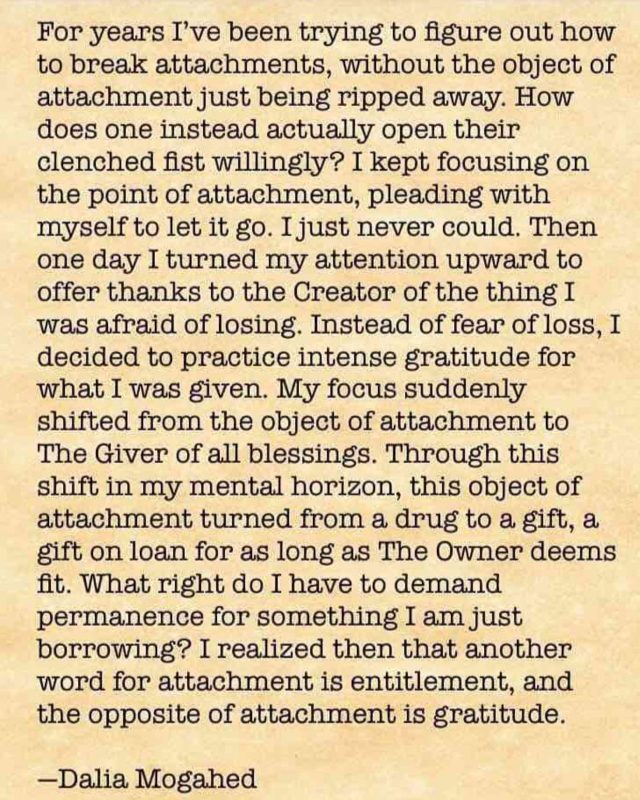
This reminds me of the deeply relatable book, ‘Reclaim Your Heart’ by Yasmin Mogahed where she said, “We can’t blame the laws of physics when a twig snaps because we leaned on it for support.

The twig was never created to carry us.

Our weight was only meant to be carried by God.”

Pause. Think about it. ‘The twig was never created to carry us. Our weight was only meant to be carried by God.’ Subhanallah. How many of us have attached all of our hopes and dreams to other human beings or material stuff or an idea?

Yasmin Mogahed went on to say: “We are told in the Quran: “…whoever rejects evil and believes in God hath grasped the most trustworthy hand-hold that never breaks. And God hears and knows all things.” (Qur’an, 2: 256). There is a crucial lesson in this verse: that there is only one hand-hold that never breaks. There is only one place where we can lay our dependencies. There is only one relationship that should define our self-worth and only one source from which to seek our ultimate happiness, fulfillment, and security. That place is God.”

As I struggled through this painful experience, I had the brutal realization that I was not in control. I am just a fragile human being who cannot change my life according to my desires/expectations. Maybe it is the arrogance of my heart to think that I am entitled to get such and such a thing because I’ve strived to be a good human being always. It was like that necessary slap on the face of being put in your place. A reminder of who is the Most Powerful.

As harsh as that sounds, I saw Allah’s mercy on me through it all. Immediately after this particular loss, I got a series of very demanding works. I was so absorbed, so exhausted, so overwhelmed, that I barely had time to think. And even on the much painful days when I’d cry myself to sleep, or had constant dreams about it, I’d always notice Allah’s compassion towards me.

I remember one particularly hard morning, a friend texted me quite early and gave a very beautiful review of my book ‘The Striving Soul’. She used such kind words to describe me and my work that it brought tears to my eyes. A couple of hours later, another dear friend sent a very random message to our group, thanking me for being who I am, and for inspiring them, etc, then other members of the group decided it was the time for me to receive my flowers and kept on praising me. Then AGAIN, another couple of hours later, a writer I know, texted me about how he randomly bought an anthology but he didn’t know I was one of the writers. He explained to me how he had lost his long-time wife recently and it had been so difficult to do anything, even reading. But when he saw my name he immediately read my story and it touched him so much it teared him up. He was just glad he was able to read again.

Subhanallah. I spent that whole day noticing the ‘seemingly small’ gestures of kindness from several people in my life. And I was so moved by Allah’s mercy towards me. It honestly felt like a warm embrace from God. Like a reassurance that despite this hard-learned lesson, He was there with me. Like a tag to the heart to say, ‘Unlike what you thought, you are still alive, aren’t you?’ That everything will be okay. That this too shall pass. All this, not because I am faultless, perfect, or deserving of His kindness. But because He is who He is.

Even more than that, it made me think of the many other circumstances that I so desperately feared in the past; many did not happen, and for the ones that I did, I still found the strength to persevere. Even when I did not think I could. It reminds me of the ayah, “Allah does not burden a soul beyond that it can bear.” (Qur’an 2:286) Indeed, Allah is the Most Knowing. He only tested us with whatever he tested us with because HE KNEW we can endure it. It will not be a test if it won’t be painful. So the pain is inevitable. But the strength to go through it all? Allah will give you that, and more…

Suddenly you’ll notice kind strangers doing random acts of kindness for you. Suddenly, the work you dread so much becomes a tiny bit easier. Suddenly, good people seek your friendship. Suddenly, you get a random win. Suddenly, you acquire some money you did not expect. Suddenly, a long-lost friend sends you a gift. Suddenly, someone unexpectedly offers you support with something that’s been troubling you. Suddenly, suddenly, suddenly…but is it really a coincidence? By Allah, it is not. This is Allah Subhanahu Wataala. He gives you one heavy test but grants you ease and comfort through many other ways, and sometimes, different aspects of your life.

I remember sometime last year, a young lady randomly texted me on Instagram. She had come across my poems on grief and they had brought her to tears. We chit-chatted a bit on loss and the pain of grief and that was it. But somehow, we went on talking a little more before she confided in me that her fiancé had recently passed away, just three months before their wedding. I couldn’t even start to fathom how devastating that must have been for her. We talked a bit about it, and then a couple of days later, she started reading my book ‘Reflection and Resurgence.’

Now for whoever has read this book, you know that it has several different Islamic themes on faith, repentance, love, hope, patience, etc. Even though the book does have a few passages that could move a grieving person, it is quite a general spiritual book. However, after reading the book, she wrote me a long message and part of it said, “I just finished reading your book today. It is exactly one month since the death of my fiancé. Alhamdulilah, it is the first time since then that I can confidently say that I feel peace alhamdulilah, I literally feel happy…..Actually, I felt like I was meant to read this book. I feel like you wrote this book for me Subhanallah. Like every page in this book was like aiming me. Alhamdulilah, alhamdulilah….”

Subhanallah. I think of how Allah set us up to cross paths at the exact moment when she was deep in grief and to eventually read my book that to a small extent, eased her pain. It is not a coincidence. Not because my work is brilliant or anything like that, but only because Allah knew that the reminders I had kept therein were meant to grant her some comfort at that particular time. And I think of how often Allah showers us with His mercy through other human beings or other events, yet we don’t notice. Indeed Allah is with us, even when we are in the darkest pits of hell on earth.

As painful as this experience has been and still is, I have truly learned to accept that ‘We plan and Allah Plans, and He is the Best of Planners.’ That however much we try to make things go our way, they can never do so except by His permission. That this dunya and all that is in it is temporary. That He’ll ONLY test you with what you can bear. That Allah is Kind, He is always very, very kind and merciful towards us, we just need to see it to be grateful.

Most importantly, I quote this powerful quote I came across recently, “Do not borrow grief from the future.” And oufffff! I’ve thought about this a lot. (I think I need this plastered on my wall!) I have borrowed grief time and time again, yet when the said ‘feared future’ arrived, I still had to go through that pain. Totally pointless. Do not recommend 😄

In the end, everything is going to work out exactly how it is meant to. Another day to remind myself and you, beloved reader to ‘Let Go and Let God.’

Allah Subhanahu Wataala did not lie when He said:

“The example of those who spend their wealth in the cause of Allah is that of a grain that sprouts into seven ears, each bearing one hundred grains. And Allah multiplies the reward even more to whoever He wills. For Allah is All-Bountiful, All-Knowing.” (Suratul Baqarah, Verse 261)

I recently came across the story of Hamza, a 56-year-old man who was jailed at the age of 16 after accidentally firing a gun which led to the death of his loved one. While in jail, he became a devout Muslim and had been pleading for parole for years. Forty years later, Hamza is finally going to be released at the end of March in shaa Allah. But here’s how one act of kindness has changed his life entirely.

Hamza was working as a janitor at the prison which earned him 13 cents per hour only. Yet what he got from the 136 hours of tough labour, a total of 17$, Hamza donated all to Gaza.

Justin Mashouf, a filmmaker who was in correspondence with Hamza, shared his story on X (Twitter). Touched by this noble act of kindness, his story quickly went viral and Justin created a gofundme campaign to empower Hamza to transition back into society with dignity and security after years of imprisonment. A total of USD 102,187 was raised until Hamza requested that it be suspended (after thanking all the donors of course). Instead, he requested the donors to consider helping the suffering children, mothers and fathers of Palestine, Yemen, and Africa living under inhuman conditions. 

When I first saw the fundraising, the goal was 40,000 USD. This was more than double that. Subhanallah!

Allah Subhanahu Wataala tells us in Suratul Baqarah, Verse 265:

“And the example of those who donate their wealth, seeking Allah’s pleasure and believing the reward is certain, is that of a garden on a fertile hill: when heavy rain falls, it yields up twice its normal produce. If no heavy rain falls, a drizzle is sufficient. And Allah is All-Seeing of what you do.”

Isn’t it mind-blowing that Allah Subhanahu Wataala inspired Hamza to do this act, a mere weeks before his release (in shaa Allah)? Can you imagine what kind of worries Hamza might have had (or not) about going back into the world after 40 years?! A different name, a different religion, a totally different era, jobless, homeless, with no money. Yet the heaviest of all is the concern of whether the community would embrace him upon his release. And subhanallah, just like the best of planners Allah is, He brought a way in which Hamza got all he could ask for, at least in terms of livelihood and community, at the eleventh hour!

Someone once told me of a time when he gave a guard lunch money, it was very random, and that same day, someone he had been referring clients to, randomly tipped him ten times what he gave the guard. Literally ten times! Mind you, this had never happened before and was quite unexpected. And he told me something that really struck me. He said, ‘I pity those who don’t believe in Allah.’ And I thought, yeah! What a great loss to not know, see and feel God’s love and mercy and kindness?!

I’ll never stop preaching about charity because I have read, watched and witnessed the miracles of giving. I have seen how much Allah can give and give and give. And the stories are too many to count.

We are just a few days to Ramadhan and many people are planning menus, festivities and early Eid shopping. Let us dare be different by planning for more ibadah and charity, charity, charity! 

Times have been increasingly tough, not just in our country, but in the entire globe. But that should never limit us from giving because you know what? We have a very generous Lord, and what you give, especially when it is difficult for you to do so, will never go unrewarded. Charity does not make you poor, it elevates you more than you can imagine.

The prophet peace be upon him said: “Charity does not decrease wealth, no one forgives another except that Allah increases his honour, and no one humbles himself for the sake of Allah except that Allah raises his status.” (Sahih Muslim 2588)

Let us have our intentions set, ready for Ramadhan, and let us put in effort to make it a more productive one than it ever was.

May we all live to experience the holy month and may we be among those whose lives will transform for the better, ameen. Ramadhan Mubarak good people! Please do remember me and my family in your duas 🙂

That said, here is a charity opportunity you can begin with:

Hamza’s story source: https://www.gofundme.com/f/help-a-generous-soul-reenter-society-from-prison

“Sometimes, when Allah Subhanallah Wataala answers our prayers and grants us our wishes, He brings forth tests alongside those blessings. One could have prayed for a child for years, then Allah grants them one who is sickly or with special needs or very stubborn. Another could have prayed for a spouse, then they are granted one who really gets on their nerves or is poor. Another could have prayed for a chance to perform hajj or umrah, and then face many difficulties during the pilgrimage. Another could have prayed for a job, then got one with a merciless boss. Oftentimes, when this happens, we tend to focus on the challenges we are facing, forgetting it is a test from Allah.

Remember the words of Nabii Suleiman Aleyhi Ssalam when he said about the power and bounties granted upon him:

قَالَ هَٰذَا مِنْ فَضْلِ رَبِّي لِيَبْلُوَنِي أَأَشْكُرُ أَمْ أَكْفُرُ ۖ وَمَنْ شَكَرَ فَإِنَّمَا يَشْكُرُ لِنَفْسِهِ ۖ وَمَنْ كَفَرَ فَإِنَّ رَبِّي غَنِيٌّ كَرِيمٌ

“𝑻𝒉𝒊𝒔 𝒊𝒔 𝒃𝒚 𝒕𝒉𝒆 𝒈𝒓𝒂𝒄𝒆 𝒐𝒇 𝒎𝒚 𝑳𝒐𝒓𝒅 – 𝒕𝒐 𝒕𝒆𝒔𝒕 𝒎𝒆 𝒘𝒉𝒆𝒕𝒉𝒆𝒓 𝑰 𝒂𝒎 𝒈𝒓𝒂𝒕𝒆𝒇𝒖𝒍 𝒐𝒓 𝒖𝒏𝒈𝒓𝒂𝒕𝒆𝒇𝒖𝒍!

And whoever is grateful, truly, his gratitude is for himself; and whoever is ungrateful, certainly my Lord is Rich, Bountiful.”

Will you be grateful for the blessing? Will you be patient with the tests? Will you acknowledge Allah’s power and mercy in all that you have and do? Will you still praise Him? Will you remain steadfast and firm in your faith? Will you trust Allah’s plan?!

Indeed, we have so much to be thankful for.

Alhamdulilah for all that is gone. And all that we own. And all that is known and unknown.

الحمد لله حمدا كثيرا طيبا مباركا فيه.”

Just a couple of days ago, I wrote the above piece on my social media pages. It was just a random contemplation of life events. I didn’t expect that soon after I’ll meet the human manifestation of my post. And when I did, I was nothing short of stunned by the embodiment of patience right in front of my eyes.

Sister Zainab, just like any married woman, yearned to be a mother. She prayed for a child. She sought medical expertise on how to get a child. But she failed, again and again and again. Four years later, the Bushra came. By Allah’s mercy, she was finally pregnant. It only made sense that she would call her child Bushra- Glad Tidings, because that is what she was. Good news. A reward for her patience.

However, Zainab had such a complicated delivery that the child had to be pulled out of her womb. Bushra didn’t cry for hours. Zainab thought her baby was already lost, but Allah had other plans for her. She miraculously made it through, but there was more awaiting both mother and child…Bushra was born with severe Cerebral Palsy. 

Without knowing it, our sister’s life took a total turn after that. Her entire time and energy had to now revolve around her fragile baby who couldn’t see, move or communicate like other children. For years, Zainab carried her child everywhere. To the toilet, to the hospital, to therapy sessions, to Ruqya sessions…her life fully for her child.

Soon enough, rumours from relatives and neighbours emerged. Bushra was bewitched, she has been made a ‘kiti’ bla bla…The suggestions to visit a witch doctor to cure her child followed, while others slowly avoided her and her child entirely. Even when they would hear Bushra cry painfully, they would leave her mother to return to tend to her. It was only her mother, apart from her husband, who supported them greatly in raising Bushra. Despite having her own health complications, Bushra’s grandmother dedicated her life to helping her daughter and son-in-law. The three of them felt alienated and the stigma they have faced as a family has been real.

Being a believer, Zainab opted to put trust in her Lord and do what she knows best; pray and do more research. Zainab was always looking for ways to improve her child’s health. She attended any health seminar she heard of that was related to Bushra’s condition, and read books and research papers about it.

It is through her constant reading that she came across ‘Regenerative Brain Cell Therapy’ which has been able to assist those with severe conditions like Bushra. It gave her hope, yet it seemed like such a far-stretched option for her. She didn’t know where to start, whom to talk to, or even where she’d get the money for the treatment. Yet the thought of it lingered in her head for years, until one day when the specialists came from India to Mombasa and did a seminar about the therapy treatment. For Zainab, that was Allah making things easier and clearer for her. She was now more determined to find this treatment for Bushra, more than ever before. She thereafter travelled to Tanzania for an international health forum for ‘Autism and Neurodevelopmental disorders’ to learn more about regenerative brain cell treatment. 

You’d expect that for a woman like her, with all that she has been through, she’d be frustrated, miserable and sad. But the spirit of imaan in Allah glimmers in her eyes. She has so much belief that Allah will her through it all. That it shall get better. One thing she kept repeating to me was, ‘I have to have faith. There is no other way.’ And I’ve thought about that a lot ever since. Truly Allah does not burden a soul beyond what they can bear.

Here was a woman who could have chosen to just accept her daughter as she is and give her the medications to just manage her condition. Or she could have listened to those misguiding her into the desperation of seeking help from a witch doctor. Or worst of all, she could have abandoned or neglected the child, like other parents do. But here she was, doing everything possible in her power to make life for her daughter just a little more bearable, a little less painful, all the while seeking Allah’s pleasure.

Despite all the challenges, Allah Subhanahu Wataala never seized to bring good people to help them; sometimes financially, sometimes emotionally, sometimes with ideas, and sometimes even physically. There was especially one friend of Umm Bushra who would always look out for Bushra’s needs and help consistently. For this, Sister Zainab expressed her deep gratitude for Allah’s mercy, and sincere duas for everyone who has ever extended their kindness to them.

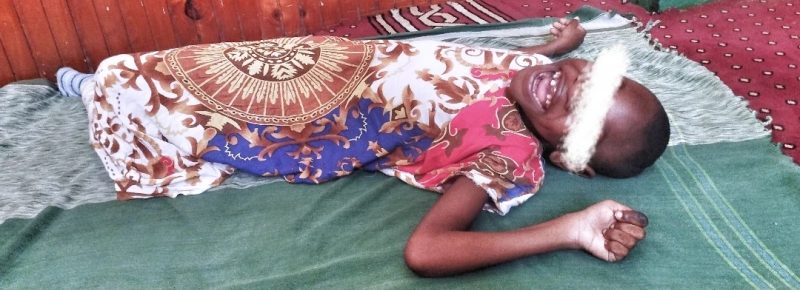
Throughout the one hour that we talked, Bushra was lying beside us with the sweetest smile, her dimples revealing, moving her limbs playfully. Sister Zainab says to me, “She loves smiling mashallah. Always smiling. I worry about her sometimes. Right now I can carry her around because she is still young, but she is growing older. She will become heavier and her needs will change. Sometimes she is bitten by an ant but since she can’t speak, she just cries so intensely, and I have to figure out what could be wrong. This Neuro Regenerative Rehabilitation Therapy is not a cure but it will help her move better. She’ll be able to at least sit up or perhaps walk, even if it is by stumbling. I have read deeply about this treatment, I know the pros and cons, and I want to tawakkal with it. The Indian doctors explained that the earlier she gets the treatment, the more effective it is. And because she is growing older each year (turning 7 this year) I really want us to travel this same year in shaa Allah.”

Here’s our beautiful, lovely Bushra. Allahumma Bareek

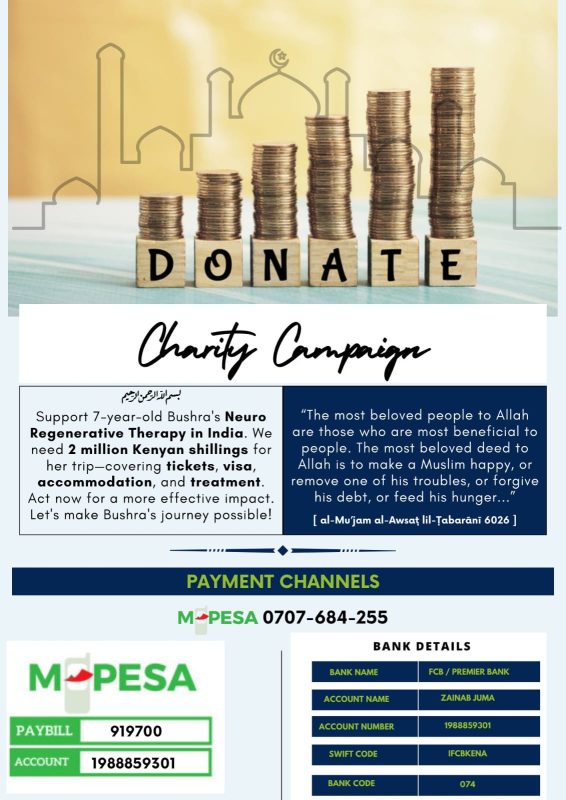
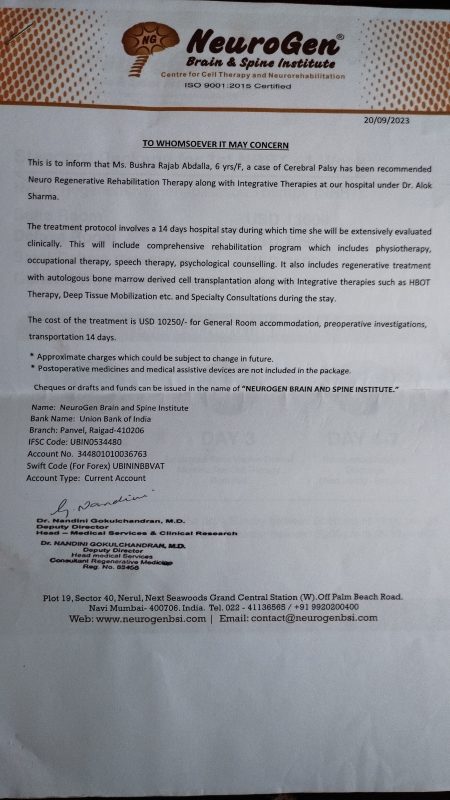
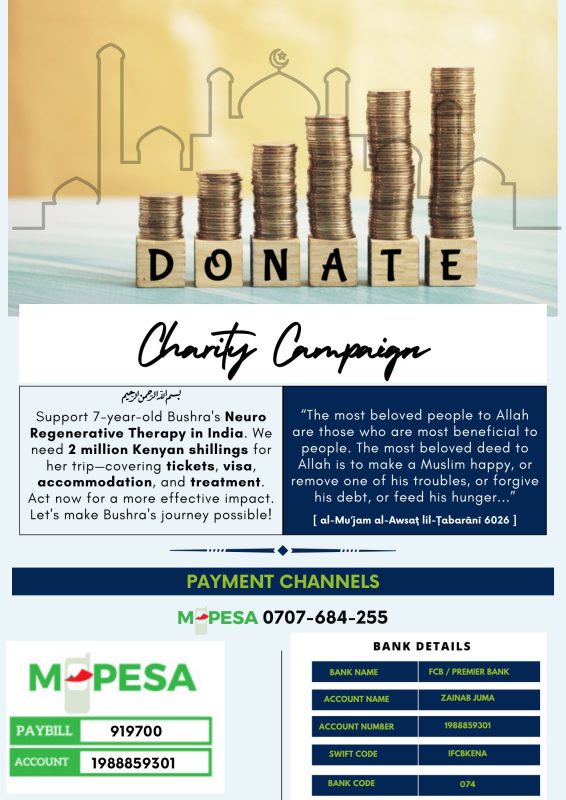
Umm Bushra needs to raise 2 million Kenyan shillings for the entire trip to India. From tickets to visas to accommodation and the treatment itself. Unfortunately, her husband is struggling financially with no stable job and Zainab has no other income since taking care of Bushra is a full-time job.

As a human being I look at that amount and think ‘Mahn, how will we raise that amount of money?’ but then I look at her patience and imaan and I remember that Allah is great and good, and very much capable of bringing miracles. 

Here’s a hopeful, devoted believer and mother seeking our help, I truly pray that we come through for her. Assist in any way you can, and please spread the word!

Let’s do this!!! Her hospital letter and donation details are below:

Abu Huraira reported: The Messenger of Allah, peace and blessings be upon him, said, “Whoever relieves the hardship of a believer in this world, Allah will relieve his hardship on the Day of Resurrection. Whoever helps ease one in difficulty, Allah will make it easy for him in this world and the Hereafter. Whoever conceals the faults of a Muslim, Allah will conceal his faults in this world and the Hereafter. Allah helps the servant as long as he helps his brother…” (Ṣaḥīḥ Muslim 2699)

You may read the third part of this article here

My very adorable boys have grown. It’s amazing watching them bloom. Don’t get me wrong, they still drive us crazy but whenever they are away, their absence is deeply felt.

My Hassun (my happy person 3) is close to four years, but now we call him Chenchen. He is the most charming of all. But he’s also got that kind of cat-ish pride, you know what I mean right? Sometimes he gives hugs and kisses and smiles abundantly, and sometimes you call him and he ignores you completely. If you keep calling his name he point blank shouts NO from wherever he is. He is only gonna love you when he feels like it. He is still my favourite though. It is an undeniable fact.

There was a time months back I went away from home for some days and every evening, I would call and the first person I would ask for is him. My aunt whom I was staying with once asked me, ‘You’re very attached to Chenchen yeah?’ I laughed and asked why. She said she rarely hears me ask about the others 😀

Sometimes I feel bad and say to myself that I don’t want the others to feel discriminated. But what is love? I cannot hide it. I get to the door of home and he is the first name I call out. I bring them sweets, and Chenchen is the first I give it to. Random times I would remember him and miss him and just say his name. SMH, I know, it’s an obsession at this point.

I noticed that whenever I left him home, he would avoid eye contact once I’m back. He would refuse to acknowledge my existence entirely. And any attempt to hug him or kiss him will be followed by a big NO. But then slooowwwllly, and with much persuasion, he starts smiling shyly then disappears, then at another moment he lets me carry him but then throw a tantrum to be left alone, then at another moment he comes to lay on my lap or if he cries, he comes to hug me. It’s like the perfect illustration of cognitive dissonance (a mental conflict that occurs when your beliefs don’t line up with your actions). It seems like he feels hurt and angry and betrayed for leaving without him, but then he is kinda happy to see you but doesn’t exactly want it to be noticed.

He is the absolute cutest. Well apart from the fact that he STILL refuses to call me by my name and calls me by my younger sister’s name instead. I think this move is very intentional; like he’s teasing me. You can’t tell me he knows how to say EXCAVATOR and MONSTER TRUCK and knows how to call our neighbour ABDULMALIK, but can’t say my NICKNAME *rolling eyes*. Sometimes, when he is repeatedly begging me for something, chorusing my sister’s name, he has a mouth slip and says Luby. It’s like once in a blue moon typa thing. When he says my name, even if I didn’t want to do whatever he was requesting for, my heart just melts and I do it anyway. I told my sister in shaa Allah I’ll take him with me once I have my own home but my mum stopped me in my tracks with ‘Tafuta wako!’ 😀

Chenchen’s personality is more visible now. He is very much a loner. He doesn’t mind playing alone for hours on end. You’d see him silently playing with his favourite car toys or chorusing the car noises as he hears them on TV, with intervals of high and low intonations. He is very energetic and loooveees exploring. If you take him to an open field, khalas, that’s heaven for him. He can run back and forth and back and forth like he is training for a marathon. If you leave him outside alone he will most definitely go further away. Sand and water are his favourite things to play with. He can stay the whole day playing in a pile of sand and a small cup, literally bathing himself in it. The same with water. He could cry if you remove him from the bathroom before he has enough play with the water.

Chenchen can get really silent sometimes, and sometimes he is jumping up and down and running wild. Also, if you’re wondering, yes, he still throws stuff outside the window :/

Anywayssss, Halimi (my happy person 2) is soooo compassionate and kind and sensitive and cheerful, and I really love that about him. He’s the kind to randomly give you a hug or tell you ‘I love you’ or kiss you. He’s just the sweetest and most loving kid, Allahumma Bareek! He’s the one who always wants to give his mother company while she works. When he comes back from school, he is always so excited to see any of us. He’d shout any of our names with so much joy, you’d think he hadn’t seen us the same morning. There was a time they all went to my brother’s house for a holiday. After some days, the rest of the family joined them there. When Halimi saw us approaching us, he ran towards us shouting, ‘UH! MY PEOPLE! MY PEOPLE ARE HERE!’ I could cry talking about how warm and beautiful his soul is. Whenever I see how he gets super enthusiastic about the smallest things, in my heart I pray that Allah protects his soul and that this world never takes away this gift from him.

Last Ramadhan we taught them the concept of dua and writing dua lists and so Halimi and Hassan (Happy person 1) started creating their own duas and sometimes writing letters to Allah which mostly consisted requests for toys and toys and more toys. Several months later, Halimi came to me one night, requesting for a paper and pen. He was visibly sleepy but he insisted he wanted to draw. So I gave him what he needed and to my pleasant surprise, he had drawn a toy phone and police car then wrote a letter to Allah requesting for the two. My heart melted. I did not expect that months later, he’d still remember that and even though he was pressed with sleep, he still wanted to communicate with Allah *happy teary eyes*. May Allah guide them and protect them and make them among His most beloved servants, ameen.

Halimi is also the reader and creative in the house, which of course makes me love him more. Whenever he comes across a book he’ll be curious and try reading it even when it is beyond his age. He also loves drawing and colouring and mashallah he is good at it too! He’s such a sensitive boy so you CANNOT make him cry. Because he doesn’t simply cry. HE WAILS! The entire neighbourhood will hear his screams and assume the worst.

The two older boys are at the curiosity phase where they ask very many simple yet difficult questions. Hassan especially is very inquisitive. Both he and Halimi would out of the blue ask, ‘When are we going to Allah? Where is Allah? Does Allah pray? Is Allah boy or girl? Where is Jannah? Can we go to Jannah then we come back?’ Just this month, as he (Hassan) was turning 8, he asked his grandmother, ‘How many years remaining then we go to Jannah?’ Hahaha. Another time he randomly said he doesn’t want to go to hellfire. Another time he said he doesn’t want to go to shaytan. There was a time he was so tired and sleepy but he hadn’t prayed ishaa yet. So he started getting teary saying he doesn’t want to go to hellfire because he has been taught after 7 years a child should pray all prayers miskeen. He takes his prayers very seriously and we love that for him 😀

They recently started being given chances at the masjid to do iqamah and they are always so excited about it, especially Halimi. They would race to the masjid and whoever gets there first does the iqamah, but Halimi would cry whenever defeated and Hassan, being the responsible, thoughtful elder brother, let’s him do it any way 😀

Hassan still loves maths and he is your typical first born. Sharp, caring, responsible and very thoughtful of his younger siblings. He’s also become a master in solving rubric cube after many many attempts. At the beginning, because he couldn’t solve it, he used to remove all the individual cubes then return them one by one in the order of the colours just so that he can proudly say he did it 😀 Thereafter, my sister started watching YouTube tutorials with him until he learnt how to do it better than my sister! He’s our little genius, Allahumma bareek.

But nooow, we have a new squad member who started living with us. My niece Mima is very pretty mashallah and very naughty. She is very sweet and loving and affectionate. You should hear her talk about her mummy and daddy, like the proudest child in the world. She is especially very very attached to her father. You should see her excitement when she sees him, and how much she cries when he leaves her behind, ‘DADDDYYYYY! I WANT MY DADDDYYY!’.

Mima loves freely and deeply and never shies off from expressing her emotions. When introducing herself she says ‘Mima pwinshesh’ while smiling cutely. Her smile can melt your heart but you cannot let that deceive you! 😀 Mima is like Masha from ‘Masha and the Bear’. Her teachers cannot tame her either and any attempt to do so brings out the sensitive, cry baby in her. Talk of ‘terrible twos’ extending to three, four years now 😀

Granted, she began school a few months before she officially turned four, but to date, both her school and madrasa teachers always have a lot to say about her 😀 We understand though; she’s young. As they say, ‘Akikua ataacha’ (or so we hope! 😀 )

Halimi is her best friend. Those two, are partners in crime. They’ll intentionally do what you specifically asked them not to, just so they can push your buttons while they have smug smiles on their faces. Kids really know how to get on your nerves and drive you crazy, but when they are absent, you still miss them somehow. Her and Chenchen on the other hand, are frenemies. One minute (most of the times) they are fighting over toys or food, the next minute Chenchen is shouting, ‘Let’s go Mima. Let’s play!’ or hanging on the grills of the window (even after you’ve told them 648765487 times not to do so!)

Regardless of all that, Mima loves to help around and to be involved. She’ll throw the pillows down with the boys but she doesn’t mind returning them at their rightful place. When the older boys are sent to the shop, she wants to join too. Plus she’s the only one among them who stays with their toys intact for more than two days (boys will always be boys!)

I’m writing this because I miss them all so much. They’ve all gone for holidays to their families and the house feels empty, and kinda boring (except for the part where we can sleep with no disturbances 😀 ). I’m already here nagging their mother to start preparing for January school opening like I am mother hen. But then it is no secret that I am THAT mother (in shaa Allah). The one to prepare breakfast items the night before so there is no morning rush 😀 Spoiler Alert: There’s ALWAYS morning chaos! SMH 😀

Anyways, may Allah protect my babies and make them kind, brilliant and pious Ya Rab. Please do pray for their guidance 🙂

*

P.S: Don’t forget to pray for Palestine, Sudan, Lebanon, Congo and all the countries undergoing oppression.

Thank you for reading! Kindly do subscribe below to keep up with my latest blogs 🙂

Devastating. Shocking. Agonizing.

We are witnessing a genocide live on our screens. An ethnic cleansing. Another nakba.

Shouldn’t the world pause?! Shouldn’t we all drop everything in our hands and DO something?! Shouldn’t we all be ENRAGED?! How are we able to enjoy life like a massacre isn’t taking place? How are some people okay with this?! Are people blind? Aren’t they seeing what we’re seeing?!

A brutal occupation. Living in an open prison. Bombing after bombing. Chemical weapons such as white phosphorus being artillery-fired. Flattening of entire neighbourhoods. Entire lineages are being wiped out. Severe starvation. Children writing their names on their palms so they can be identified if they die. Lifeless bodies lying across the streets. Rubble everywhere. Ice cream trucks being used to store dead bodies. Parents swapping children so that someone in their families survive. Women having their full hijab on all the time in case they get killed at any moment. An impossible evacuation of 1.2 million people. Constant terror. Constant death. Constant grief, that mind you, the Palestinians don’t even get to process because they need to educate and show proof of their suffering every.single.time. Yet some people still deny it!

How can we stay sane while feeling the most helpless ever?

This is how a society goes down the drain really quickly. First, we overlook evil. Then we permit evil. Then we legalize evil. Then we promote evil. Then we celebrate evil. Then we persecute those who still call it evil.

@truth.to.the.rescue on IG

Indeed Palestine will always be a sore wound for humanity until they acquire their freedom, rights and their land. And in that is a lot for us to ponder on.

1. The pen has been lifted and the ink has dried: Part of our faith as Muslims is the belief that everything is destined by Allah through His all-encompassing knowledge and wisdom. That includes all the good that happens to us but also, all the seemingly bad that happens to us. What is happening in Palestine right now is a huge test, not just for the people of Palestine, but for us too! How firm is our faith? How will we stand with our brothers and sisters in their struggle? How will we act as we watch all these devastating horrors in front of our eyes? WHAT WILL WE DO ABOUT IT?! So despite the pain and helplessness we immensely feel for the Palestinians or any other suffering nation, let us not forget that Allah is still and always in control. That HE knows of the oppression taking place. That He has a plan. That He knows what He is doing. That victory will indefinitely come for the Palestinians, and that we should trust HIM.

And We warned the Children of Israel in the Scripture, “You will certainly cause corruption in the land twice, and you will become extremely arrogant.

Suratul Israa, Verse 4

On the authority of Abu Abbas Abdullah bin Abbas (may Allah be pleased with him) who said: One day I was behind the Prophet (peace and blessings of Allah be upon him) [riding on the same mount] and he said, “O young man, I shall teach you some words [of advice]: Be mindful of Allah and Allah will protect you. Be mindful of Allah and you will find Him in front of you. If you ask, then ask Allah [alone]; and if you seek help, then seek help from Allah [alone]. And know that if the nation were to gather together to benefit you with anything, they would not benefit you except with what Allah had already prescribed for you. And if they were to gather together to harm you with anything, they would not harm you except with what Allah had already prescribed against you. The pens have been lifted and the pages have dried.”

In another narration, the hadith reads: “Be mindful of Allah, and you will find Him in front of you. Recognize and acknowledge Allah in times of ease and prosperity, and He will remember you in times of adversity. And know that what has passed you by [and you have failed to attain] was not going to befall you, and what has befallen you was not going to pass you by. AND KNOW THAT VICTORY COMES WITH PATIENCE, RELIEF WITH AFFLICTION, AND HARDSHIP WITH EASE.” (Hadith 19, 40 Hadith an-Nawawi)

So even as we shed tears and our hearts ache for our brothers and sisters (rightfully so), let us not forget that Allah, in His wisdom, allowed it to happen. The people who’ve been martyred were meant to be martyred. Those who are getting injured have been destined to get those injuries. Those whose houses were bombed, were meant to lose their homes. Those lineages that have been wiped out, that is what was destined for them. Qaddara Allahu wa ma sha’a fa’ala. Allah has decreed and whatever he wills, He does. And in Him we should always fully trust.

2. This dunya is nothing but a test.

أَحَسِبَ ٱلنَّاسُ أَن يُتۡرَكُوٓاْ أَن يَقُولُوٓاْ ءَامَنَّا وَهُمۡ لَا يُفۡتَنُونَ

وَلَقَدۡ فَتَنَّا ٱلَّذِينَ مِن قَبۡلِهِمۡۖ فَلَيَعۡلَمَنَّ ٱللَّهُ ٱلَّذِينَ صَدَقُواْ وَلَيَعۡلَمَنَّ ٱلۡكَٰذِبِينَ

أَمۡ حَسِبَ ٱلَّذِينَ يَعۡمَلُونَ ٱلسَّيِّـَٔاتِ أَن يَسۡبِقُونَاۚ سَآءَ مَا يَحۡكُمُونَ

“Do people think once they say, “We believe,” that they will be left without being put to the test?

We certainly tested those before them. And ˹in this way˺ Allah will clearly distinguish between those who are truthful and those who are liars.

Or do the evildoers ˹simply˺ think that they will escape Us? How wrong is their judgment!”

Surat Al Ankabut, Verse 2-4

Allah Subhanahu Wataala did warn us that we’ll be tested, our faith will be tested in all kinds of ways; earthquakes, bloodshed, hunger, floods, death and more. Each one of us is tested in a different way in this world, and this is how Allah separates those who are truthful in His way and those who are not. And on the day of judgment, each one of us will be rewarded according to how lived our lives on this earth. That includes the oppressors who will have to face Allah Subhanahu Wataala and taste the heavy consequences of their actions.

Do you think you will be admitted into Paradise without being tested like those before you? They were afflicted with suffering and adversity and were so ˹violently˺ shaken that ˹even˺ the Messenger and the believers with him cried out, “When will Allah’s help come?” Indeed, Allah’s help is ˹always˺ near.

Suratul Baqarah, Verse 214

The prophets were severely tested. The pious predecessors were severely tested. And Allah Subhanahu Wataala decreed this specific test for this specific group of people. We shouldn’t ask why or why them? Allah already promised us that He wouldn’t burden a soul more than they can bear. So for HIM to choose THEM for THIS TEST, it is because He knows how brave they are. How courageous they are. How unshakeable their faith is. How despite the terror, anger, angst, sadness, pain, hunger, they can still smile and say Alhamdulilah and make sijdatul shukr and make jokes and show gratitude and compassion everyday. Truthfully, they are the strongest warriors we’ve ever come across; all of them! From their men to their women to the children to their elderly! We probably would have died of fear and panic if we experienced what they go through in just one day.

Those who were warned, “Your enemies have mobilized their forces against you, so fear them,” the warning only made them grow stronger in faith and they replied, “Allah ˹alone˺ is sufficient ˹as an aid˺ for us and ˹He˺ is the best Protector.” So they returned with Allah’s favours and grace, suffering no harm. For they sought to please Allah. And surely Allah is ˹the˺ Lord of infinite bounty.

Surat Al Imran, Verse 173-174

3. These people are indeed very, very special. Here’s why:

It was narrated from Mus’ab bin Sa’d that his father, Sa’d bin Abu Waqqas, said: “I said: ‘O Messenger of Allah, which people are most severely tested?’ He said: ‘The Prophets, then the next best and the next best. A person is tested according to his religious commitment. If he is steadfast in his religious commitment, he will be tested more severely, and if he is frail in his religious commitment, his test will be according to his commitment. Trials will continue to afflict a person until they leave him walking on the earth with no sin on him.’”

I came across an image that said, ‘There is no substitute for Palestine except paradise’ and truly, that is what awaits them biidhnillah. The individuals being killed in Palestine are considered martyrs as proven in a hadith of the prophet peace be upon him, ‘Whoever is killed protecting his wealth, he is a martyr. Whoever is killed protecting his family, he is a martyr. Whoever is killed protecting his religion, he is a martyr. Whoever is killed protecting himself, he is a martyr.'” (Sunan an-Nasa’i 4095) And do you know what’s the reward for the martyrs? Allah Subhanahu Wataala says in Surat An Nisaa, verse 69 and 70: “And he who obeys Allah and the Messenger -they shall be with those whom Allah has favoured -the Prophets, those steadfast in truthfulness, the martyrs, and the righteous.” How excellent will they be for companions! That is a bounty from Allah, and Allah suffices to know the truth.” Subhanallah, indeed what awaits them is beyond our comprehension.

Never think of those martyred in the cause of Allah as dead. In fact, they are alive with their Lord, well provided for—rejoicing in Allah’s bounties and being delighted for those yet to join them. There will be no fear for them, nor will they grieve.

Surat Al Imran, Verse 169-170

4. Allah is Al-Baseer (The All-Seeing): The All-Noticing, The One who Sees all things that are seen by His Eternal Seeing without a pupil or any other instrument.

As-Samee(The All-Hearer): The One who Hears all things that are heard by His Eternal Hearing without an ear, instrument or organ.

Al-Muntaqim (The Retaliator): The One who victoriously prevails over His enemies and punishes them for their sins. Allah is most patient, but the time will come when justice must be given. 

Al-Muqsit (The Just One): The Equitable, The One who is Just in His judgment.

Do not think that Allah is unaware of what the wrongdoers do. He only delays them until a Day when ˹their˺ eyes will stare in horror—rushing forth, heads raised, never blinking, hearts void.

Surat Ibrahim, Verse 42-43

Abu Hurayrah said: The Messenger of Allaah (peace and blessings of Allaah be upon him) said: “There are three whose du’aa’ is not rejected: a just ruler, the fasting person when he breaks his fast and the prayer of the oppressed person. It rises above the clouds and the gates of heaven are opened for it, and the Lord, may He be glorified, says, ‘By My Glory I will answer you even if it is after a while.’” (Saheeh al-Tirmidhi, 2050.) 

Indeed Allah can hear the cries of the people of Palestine, He can see their pain and He definitely hears their duas. Allah will definitely come through for them, it is just a matter of time.

5. There is a post I wrote a few weeks back on my Instagram on patience that is also very, very relevant to this scenario and to our brothers and sisters in Palestine and other oppressed countries:

Whenever this dunya becomes heavy on the chest, I always ponder on this ayah:
 إِنَّمَا يُوَفَّى الصَّابِرُونَ أَجْرَهُمْ بِغَيْرِ حِسَابٍ
“Certainly those who observe patience will be given their reward in full without measure.”
And it fills my heart with awe in anticipation for what Allah has in store for us. Can you imagine? The Lord of the seven heavens, the seven earth, every single creature and non-living thing in this world, is promising a reward without measure. Without limit. A Lord who is the Most Generous, Most kind, what do you think He has prepared for us? What exactly does ‘No Limit’ mean for HIM? Definitely something beyond our human mind’s comprehension.

Think of this man for example:The Prophet (ﷺ) said, “I know the person who will be the last to come out of the (Hell) Fire, and the last to enter Paradise. He will be a man who will come out of the (Hell) Fire crawling, and Allah will say to him, ‘Go and enter Paradise.’ He will go to it, but he will imagine that it had been filled, and then he will return and say, ‘O Lord, I have found it full.’ Allah will say, ‘Go and enter Paradise, and you will have what equals the world and ten times as much (or, you will have as much as ten times the like of the world).’ On that, the man will say, ‘Do you mock at me (or laugh at me) though You are the King?” I saw Allah’s Messenger (ﷺ) (while saying that) smiling that his premolar teeth became visible. It is said that will be the lowest in degree amongst the people of Paradise. (Sahih al-Bukhari 6571) 

Subhanallah, if this is what the last person to enter Jannah is given, what more should we hope and expect from our Rab? How much more merciful, loving, generous is He?

Jabir narrated that the Prophet (s.a.w) said: “On the Day of Judgement, when the people who were tried (in this world) are given their rewards, the people who were pardoned (in life), will wish that their skins had been cut off with scissors while they were in the world.” (Jami` at-Tirmidhi 2402)

So bear a little more, dear believer. Whatever you’re battling through silently;
فصبر جميل والله المستعان
“So patience is most fitting. And Allah is the one sought for help.” 

These are very trying times for the people of Palestine but the reward they will get from Allah will make us envy them. At the very least, they know they have reserved spots in Jannah biidhnillah. We don’t. May Allah grant us all the highest levels of Jannah, ameen.

As Muslims, as human beings, we have an obligation towards those in Palestine. We must be outraged by what is happening to them. We must speak up. We must create awareness and educate the masses about the history of Palestine and the oppression taking place. We must teach our young ones about Al Aqsa and its rich history to the Muslims and why it is so important to us (Can check out this video for that: Palestine ). We must use all our platforms to share their stories, and their dreams, and their cries, and their culture. We must boycott Israeli products. We should never allow people to think of Palestinians as just numbers. These are human beings, and they desperately need to be treated as such! Never underestimate the power of coming together and being a voice for the voiceless. We must never get tired, we must not lose hope. Alhamdulilah we are very, very privileged to be able to even put our phones away when we feel overwhelmed by their news and videos. They however have been experiencing this terror throughout their lives! We thus must never get tired!

Allah’s Messenger (ﷺ) said, “You see the believers as regards their being merciful among themselves and showing love among themselves and being kind, resembling one body, so that, if any part of the body is not well then the whole body shares the sleeplessness (insomnia) and fever with it.

Sahih al-Bukhari 6011

Most importantly, we must make constant and sincere duas for them. Let’s wake up even for one night and pray tahajjud and cry to Allah about them. Let’s remember that dua can change qadr, and perhaps it is through our frequent duas for them that Allah grants them victory sooner. Do not for one moment underestimate the power of dua, or Allah’s power to change everything in just ONE INSTANCE. Let’s thank Allah for the blessings of life, food, water, clothing, roof and family. Let us seek Allah’s forgiveness for our shortcomings and our ingratitude. Let us seek refuge in Allah. Let us not stop praying for them!

Additionally, let’s sacrifice what we have, however little, and donate it to them. It doesn’t matter how little you think it is. The People in Gaza are starving, lack medical aid, lack water…they basically have nothing. So I kindly urge you to sacrifice what you have and biidhnillah, in the hereafter, they will mention our names as those who stood by their side.

Here are some ways you can donate to the people of Gaza and Palestine:

Powered by WordPress